Cultural Death By Capitalist Cinema
POST VIA LIBERATION LIT
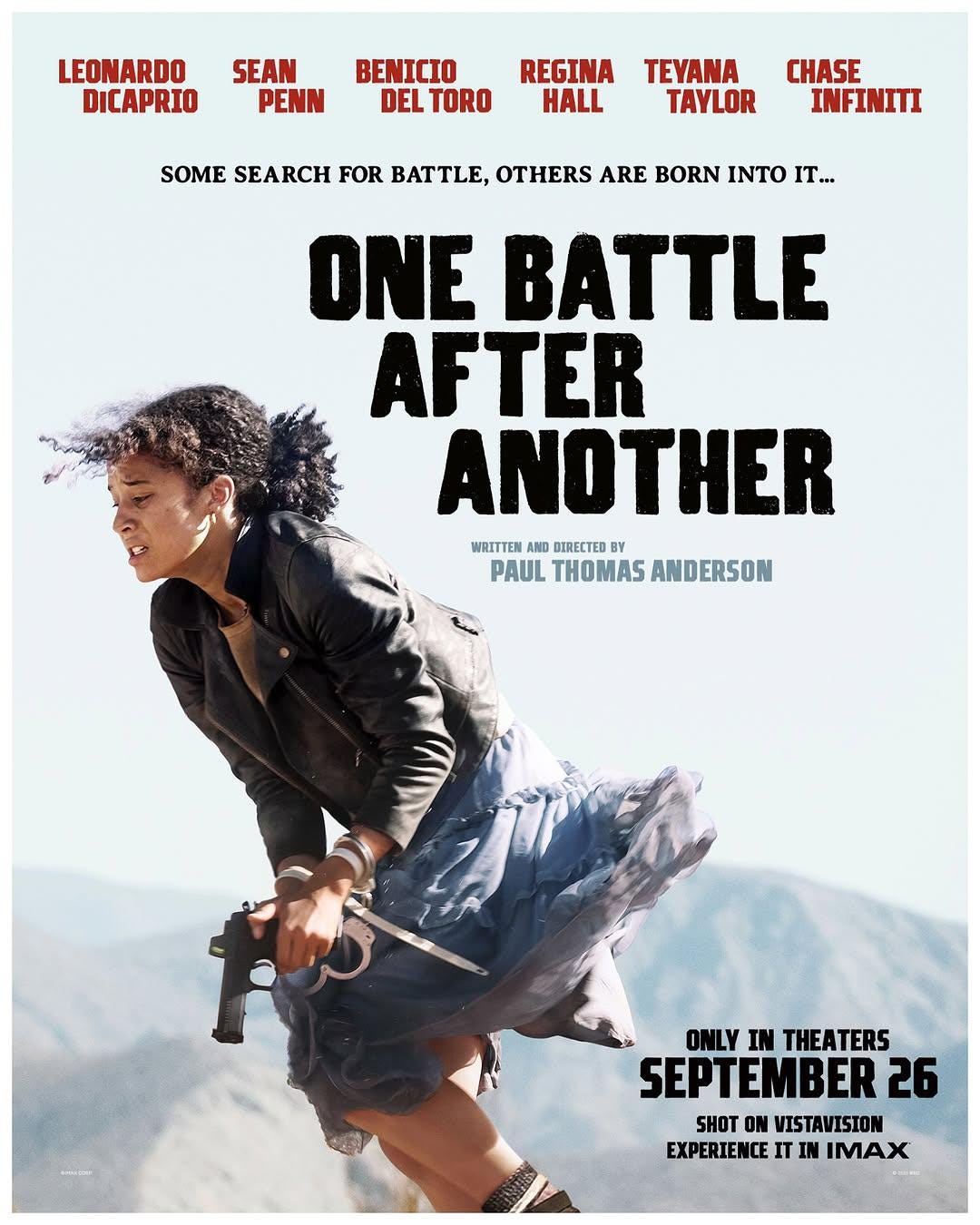
A few thoughts on Director Paul Thomas Anderson’s One Battle After Another (Warner Bros. Pictures) released September 26 — or, how not to make a liberatory movie.
One Battle After Another comes complete with a nondescript title that gives away the weak episodic movement of the structure even though it’s loosely causal, technically. The story moves from one spectacle to another such that, as it turns out, there is mainly spectacle and next to no story and content.
The movie opens and sometimes continues as a “blaxploitation” flick that otherwise tries to present as a topical thriller. The main character is entirely miscast as a white male, a comedic white male, no less, in a movie that revolves entirely around sobering and grim race and class issues. Meanwhile, a satiric virtual side-story of militant and rich white males is tagged on by means of insulting blaxploitation and pasted into what little plot there is.
The plot? The story? Weather Underground type revolutionaries liberate immigration prison camps and rob banks to fuel their revolutionary ideas circa 2010. A revolutionary as new mother is captured after killing a bank guard, and then gives up her allies to the authorities. This allows her to escape to Mexico never to be heard from again. Her male partner goes underground into rural America with her infant daughter, and they live quietly until the present day, when they are hunted down by the militant state while the daughter is in high school. A racially motivated chase and hostage tale unfolds replete with militant white plutocrat supremacists. The mixed race daughter is pursued and held hostage while the white dad both flees authorities and attempts to find and save her. Spoiler — but you knew it would work out, no? It’s Hollywood: The daughter saves herself as it turns out, while her Dad is saved by surviving revolutionaries and other social justice workers, mostly minorities. The white supremacists are fought off, if not beaten. Sounds socially conscious and good?
There are some problems. 2 hours and 45 minutes of problems. There is precious little content in the entire 2 hours and 45 minute run of the movie. Next to nothing happens, nonstop. And what does happen is often, well, wanting.
The mixed genres of the film are crudely thrown together: violent rich white males in the movie are presented satirically; the empathetic white male lead is presented comedically; the female and minority characters are treated as haphazardly dramatic, cheeky, hip, larger than life, super savvy, or victims. The plot is threadbare. The character exploration is near zero. Any social discourse is severely muted, even in face of and despite a few telling visuals.
The continuous musical score is interesting and compelling about ten percent of the time and otherwise serves as sheer filler in place of story and content, or is redundant of the continuous spectacle, again in place of story and meaningful substance. And the music is relentless on your skull less like a lively ticking clock and more like a psychotic woodpecker. Because so little of substance actually happens in the film, the score sometimes gives a chewing gum like relief. But you often want to spit out the gum and can’t.
The arbitrary and unearned slapstick transformation of the main character from revolutionary and doting dad to burnout bumbler doesn’t play much better in the movie than do the too-thin cartoon characters play in the Thomas Pynchon novel Vineland, on which the movie is remotely based.
Go back and take a look at a century of macropolitical movies, or nominally macropolitical movies, with at least some modest leftish bent made from the time of Charlie Chaplin’s Modern Times and The Great Dictator and you’ll find that they are almost all made by men, very much like all American Presidents have been men. The Presidency, like this type of movie, consequently suffers greatly as a result. It’s long since time for macropolitical movies to be made by leftish women directors and especially by women of color directors just as it is long since time for women and women of color Presidents to preside in the most powerful country of the capitalist empire — for the purpose of changing its whole nature.
Had that been the case for this film, it’s not difficult to think that the minority exploitation and the wholly superfluous white male lead elements of the movie would have been cut or not even considered in the first place. And any need for spectacle would be far reduced, by building up the substance of social discourse and character development, with not unrelated and far better control of plot, and actual content and character revelation in dialogue.
It’s not that a white male director or writer is incapable of doing all this with an exposé of white empire and with characters of all races and backgrounds in macropolitical movies (or novels), it’s just an absolute rarity to see it in big American cinema, and in establishment literary novels.
In collaborative ventures like movies, you should collaborate. Paul Thomas Anderson clearly needed some help in this regard. I would not want to see my three anti-empire novels be treated like this film, at all. The novels involve a diverse populace of characters, Loop Day and Empire All In and Most Revolutionary — and if these novels would ever be filmed, then either the directors or script adapters or both should be women of color to add and combine their perspectives of life in white Empire to my own depictions. Similarly, if these novels would be adapted into TV shows, then the script adapters or showrunners or both should ideally be leftish women of color to give a broader spectrum of insight on the diverse cast of characters and the charged personal, social, and political situations.
Theoretically you could get by without such diversity among the creators but it would be difficult to do. There are so many reasons to absolutely want cross-race, cross-sex, and cross-class collaboration, especially for such sweeping macro projects. You still need a core group of creators with leftish, progressive populist sensibilities that overlap with the progressive populist ideology of the novels, otherwise you might as well surrender the thing entirely to corporate executives. One Battle After Another could have benefited enormously from a diverse writer and director collaboration rather than Paul Thomas Anderson proceeding all by his lonesome, with a white male lead no less. It’s painfully obvious. The great diverse cast salvages what can be salvaged in such a setup, mainly including Regina Hall, Teyana Taylor, Benicio Del Toro, and Chase Infiniti.
This is a Hollywood director’s spectacle of a film, not a writer’s movie of revelatory consciousness and story. The movie is far more about imagery as warped Hollywood caricature than compelling narrative and insight. The caricature of spectacle manufactures continuous decapitation of thought, even though it is said a picture is worth a thousand words. Clearly the reason so much money, or any money, was thrown at this movie is the moneymaker himself, Leonardo DiCaprio. Put Leo in the film and you’ll get your money back! What do we do with him? Make him the main character. Brilliant! Except he’s superfluous to the story. Nothing is about him. He’s a pointless main character — played off literally as a running joke to no end, no point, no purpose. He’s there in the movie for reasons that have nothing to do with the story. He’s there to get the thing funded. And it guts the movie.
DiCaprio is talented but in the way. There is far more drama, theme, meaning, reality, and possibility to be found in the excellent (when not exploited) black women characters and their stories, especially if they were to raise the daughter of the runaway mother, rather than the do-nothing beside-the-point DiCaprio character. DiCaprio gets in the way of anything interesting in the movie and everything that is most meaningful. The DiCaprio story is hollow and vacuous and spans the entire length of the film. The farce of following this guy takes up the space in which the great issues could be fully engaged. In this way the actually compelling events and characters are badly slighted, almost all people of color. Also, the vicious militants and supremacists of the plutocracy of white empire are skewered far from any real office of power, and far from any systemic illumination of their violent and profiteering oppression.
One Battle After Another? One spectacle after another. One mistake after another. One wasted moment after another. One DiCaprio after another. One PTA after another. If you could only get DiCaprio and PTA and the Hollywood executives out of the film you could have something far more vital and meaningful.
“A” for effort, I suppose, great enthusiasm wholly flawed. Warped and hollow result. The supporting cast far outdid the boss class in this one. A pity to be so badly handicapped by the funders and the conventional stars. Spanning seldom seen small cities and the vibrant countryside of the American northwest and southwest, at least the movie is sometimes scenic and the music is sometimes good though robotically overdone. Exasperated scoffing should more likely be summoned from the audience than great emotions, if you’re paying attention at all, not least when the main character is onscreen. While the movie is a vacuous, twisted mess thanks to the writing, directing, and structure, the actors are good or better. Why can the actors be such accomplished professionals and the writers, directors, and corporate executives such tools of capitalist power? To ask is to answer.
Look who’s in charge. Not the people. The power is elsewhere. Until the people come to power and a progressive populist ideology prevails, the movies will be mainly spectacles cast by the plutocracy, with all the prevailing whiz-bang, gee wow, and psychotic dross that that entails. If you go see this gutless, garish spectacle of a chase movie, you’ll need to bear it for what it is — a vapid caricature of physical movement and social movements — and what it is not — a critical cultural moment on the path to a better future.
The actors go for what’s vital more than the movie does. The movie was made to push flash-bang as content and does not even offer clichéd platitudes as theme. Just one spectacle after another. What is to be done by the socially conscious observer? Flee, or hang on to the best of the characters and the best moments in a few scenes, especially the scenes of scores of people in distress, and dream — dream of what might have been. An entirely different movie, an entirely different story of and for our perilous times.
A Stoner Dad and a Murderous Sheriff Go To War —
Eddington Versus One Battle After Another
POST VIA LIBERATION LIT
 A Practical Policy