A Feminist Press Title
POST VIA LIBERATION LIT
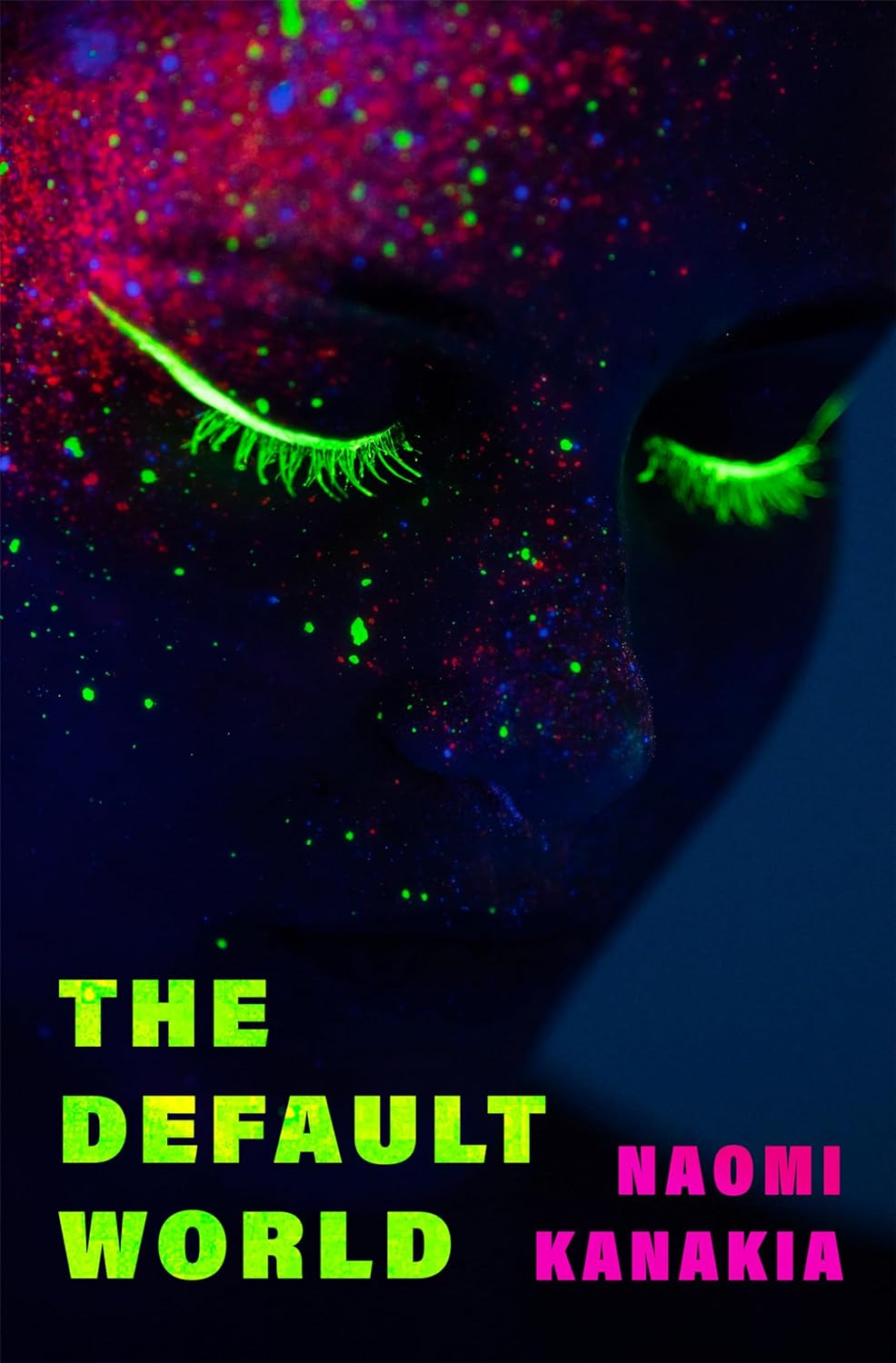
“Excuse me, but are you trans?”
Thus opens the free-rambling sometimes biting dramedy of Naomi Kanakia’s rough and raw first literary novel, The Default World. The novel presents a nipping critique and exploration of a world wherein “Excuse me, but” begins to set the bold tenor of the narration, though the novel often reads like one long cancel culture party at, say, Oberlin College — with all the psychologically intoxicated highs and lows that that may entail — while the main characters are twenty-somethings who live in San Francisco.
Kanakia can write, even as the story spins its wheels, which some might see as more a feature than a bug. A lot of the novel reads like a description of twenty-somethings who act like they are in their early and mid teens, or like a flock of fiery siblings who take turns thinking, suggesting, and essentially declaring, “I will kill you! And your whole life!” “No, I will kill you. And your whole life!” And then they make up with each other the next day — or they don’t.
If you like Céline, Houellebecq, Dostoevsky, and Ralph Ellison, then there’s no reason you should not like The Default World.
There’s an interesting class or class conscious line that runs through the novel, as the main character, Jhanvi, cannot afford multiple transition surgeries — or even housing. The aggressive and self-loathing, confident and self-effacing, self-propelling protagonist Jhanvi schemes to extract what resources and friendship she can from the wealthy clique she knows and hangs with while critiquing them, sometimes disparagingly. Love is also an immediate yet frustrating and seemingly distant goal.
This class line, class consciousness in the story is extremely truncated. All the focus of the class conflicts, pressures, and needs are pushed on Jhanvi’s acquaintances and sometimes receptive, sometimes skittish friends, also on the overwhelmed far-off parents, rather than on any sector or feature of society — government, religion, the media, or other organizations and officials.
Thus the stark but clipped class critique and exploration is made almost entirely a personal and cliquish matter, rather than a more encompassing societal critique, which creates nonstop personal civil war among the characters in their assigned roles, with essentially no thought or action or exploration toward social and political struggle. Bits of slightly broader class critique crop up, if micro-targeted, essentially clique-based too — Jhanvi wouldn’t fit in with this crowd or that crowd, and so on. To note the class limitation of this type of novel is not necessarily to criticize it but to critique it, perhaps it needs be pointed out. A criticism would be the sort of analysis I often put forth at length elsewhere — institutional analyses of literary forces and production, which I touch on later, though barely.
Kanakia loves to drop very novelistic reflections and takeaways on the personal scenarios and micro-social happenings and ways of thinking and being. It’s all very scrutinized, the plight of Jhanvi and her view of her default crowd, in this social and biological transitory (yet enduring) stage of her life — a study of alienation, resentment, kinship, and other modes of being in a soul-crushing situation where needs go badly unmet. To this distinct quest for fulfillment and the meeting of basic needs, the novel gives indelible witness and makes every attempt at felt comprehension.
The story consists of very domestic and personal drama and relationships much in keeping with the dominant ethos of commercial and establishment liberal publishing. Ironically — given Kanakia’s critical use of the title phrase of the novel — this sort of fiction is the default world of publishing. Otherwise, the novel is part of the limited though badly needed advance from the previous default world of publishing that existed decades ago, prior to the multicultural expansion, broadly defined.
There is much play with the notion of the scoundrel that helps propel the novel — the righteous and aggressive, turbulent and scathing Jhanvi pushing the conflicts and questions and paradoxes that drive story, along with the stoking of anger, desire, and fears. The rapscallion energy of Jhanvi is functionally propulsive even as some of the dramatizations and discursive breakdowns of the antagonisms between the narrator and everyone else are also the most belabored and drawn-out swaths of the novel, as if the author were searching for enough interpersonal conflict to sustain a novel-length quest and adventure story.
The inclusion of more broad or more systemic societal critiques would make the novel more capacious and insightful, more whole. And at a practical artistic level, doing so could seriously bolster the plot, character, settings, themes, and emotional fullness or resonance. Victor Hugo is a master of this in Les Misérables, the height of the novel’s accomplishment and power. Jhanvi is all about portraying herself as a misérable — a wretch, wretched — if sometimes ironically. In this case, a knowing wretch with great agency.
The critiques and dramatizations do not always land well or with much impact in The Default World, given that the targets can seem relatively simple and slight — or simpled and slighted. Jhanvi dancing with hammers among flies. The conflict for the protagonist amounts to the fact that her well-off liberal frenemies are not entirely pushovers, amid Jhanvi’s schemes to extract money and other resources from them for housing and transition surgeries and to meet other personal and social needs.
Because the protagonist operates in a near default mode of pressuring and presuming upon her target acquaintances, it would be more compelling to see ever more powerful comeuppance against Jhanvi by stronger opposing characters and plot elements biting back with far more force, either verbally or in action. There are moments. The most compelling section or two of the novel is when this actually happens, when the protagonist is pushed out and away from her place of shelter, as well as from her phone and money.
Otherwise many scenes can seem like a descent into the squabbling of young teens. The narration tries to rip through its truths but the would-be knifing criticism can come off as tuneless or immature squabbling — in isolation from a more intense gravity and greater range of more mature experience in a much larger world. Feature or bug — readers will decide. Some may lap it up, I assume. To its credit the novel handles what it can handle within its could-be city-sized but more often apartment-sized confines, and fraught excursions to bar and street and eatery, and phone.
Some descents into a naturalism of conversation and thought too often go nowhere — “one of the damned thing is ample,” thanks — or to little where, both critically and dramatically, one of the perils of realist mimicry, no matter how intent the narrative might be about precision depiction — especially then. If you’ve got something to propagandize or invent in telling your story, you should go for it like nothing else. Really make it novel. Or risk being mired in too-commonly known experience and states of being. People want more, so much more, underneath all the deathly conventions. (Not that all conventions are deathly.) Novels necessarily want to “make it new” or “make it news” and should go for it. It’s an art of course — you need to launch the work aesthetically, then follow through. That said, the especially vital new or news can make up for the bare minimum of aesthetics at least as well as great aesthetics can make up for worn out norms.
Fortunately The Default World is launched and driven by a sound set-up of character and plot, though some of the long lines of dialogue and reflection — discourse equivalent — seem to express little more than the imperative that certain well-to-do liberals should be more personally philanthropic than they are. Which is good, as far as it goes, but this only takes us so far into the big bad class-segregated and systemically ruled world of ours. After all, some liberals are very generous — if not necessarily the ones Jhanvi knows.
In any case, liberalism is not the way forward and fundamentally has not been for centuries. Sure, it’s better than fascism, the lowest of bars, and it improves upon a few other choking political ideologies but liberalism hits its own transparent dead end when tied to capitalism — as in the novel. The result, at best, is civil war — even among the upper middle classes.
Personal salvation and possibly some perceived retribution may be all that the protagonist and narrator need in this novel, but the narrator is telling the story, not receiving it. Countless others are receiving it potentially, most of whom are in situations far, far less advantageous than that of the protagonist — having not attended the elite Stanford University like Jhanvi, nor being able to wrangle their way among rich friends, nor with still other financial and personal fallbacks.
The upper middle class life mimicry and thematic conceptualization of the story is a bit confined given the wide-ranging and global situations of people everywhere — often truly desperately caught in catastrophe, life-mangled, life-ending — grim and pervasive realities of which most everyone is aware, or should be — in what might be thought of as the real default world. When readers are living in a bigger world than the novel presents, or are actively engaged with it, or are even very conscious of that bigger and more pressing world, then there can be narrative issues of gaining and sustaining attention and focus.
That said, the broad-based, street-level, and daily quests for surgery and housing, for mental clarity and human connection have their very real moments in the novel. The contentious and complicated coming-of-age personal and social struggles are intensely emotional, intellectual, and morally explored, and deserve most of the attention of the novel and sometimes get it in good measure. At other times, many of the interactions of the friends and acquaintances and narrative lines seem to tread water.
The gender and identity musings, analyses, and soliloquys of the narrator are heartfelt and rending — often conflicted, and endlessly aching. These seem the most searching and incisive parts of the novel, tying in with dramatic explorations of loneliness, exclusion, and stress-filled friendships.
Published by The Feminist Press, The Default World has found a fitting home, not least given the narrator’s ardent and explicit longing for the female and for the feminine and for a kind of justice and connection, in the personal and particular forms in which it is sought in the novel.
The Default World is a literary novel of personal self realization and multicultural peer pressure — if we understand gender and sex and even class and other forms of identity as cultural — narrative modes that may recall Kanakia’s Young Adult novel roots. And the novel contains some of the charm of quest narratives common to speculative stories of which Kanakia is also no writerly stranger.
All of a piece. Writing, stories are often cobbled together like lives and identities are cobbled together. The cobbler though as an artist does well to review and revise and reconceive with an eye toward the much greater whole, especially in the novel form, that “baggy monster” that threatens to fly part under the pressure of its mixed gravities and countervailing vectors.
The very ending of this novel — mini-spoiler alert — the end of the long last sentence — is more low-key clever and banal than powerful and resonant: “…Oh, I love her, she’s such a good friend.” An ironic joke almost, or nervous fillip. Writers often draw things out (especially online) — paragraphs, sentences, books — for one of two main reasons, the first involving great power and insight, the second involving a waffling sort of obscurity, a kind of attempt to sound good despite an underlying sense of insufficiency, incomprehension, or indecision.
I find it strange that people don’t first go to the final few paragraphs of a novel to decide if they want to read the book or not. After all, that’s where the whole thing is going and should give you a sense of the mass that came before. You cannot always tell if you will appreciate the novel by reading the final few bits but you sometimes can.
I also don’t understand people who claim to need to read blind to the end for sake of the final few paragraphs — for suspense, I guess — if such people are truly compelled in this way. A novel is a big lift. The bits are not all that much compared to the whole. So I’ll keep chipping away at any faux suspense here: the final sentence opens: “Maybe life was just filled with relationships that were” this, that, and the other. Not exactly a resounding culmination.
If you open the last paragraph with two sentences (before the final long sentence) that read, “The words weren’t right. And perhaps that was the point” then the words had better be right. You can’t beg off at this point into evasions of meaning. The meaning at the very end does not need to be grand but it does need to be spot on and not simply clever or seemingly arbitrary and inconclusive — unless those are your main themes which is not the case here. It’s not a bad ending. It seems to point to some blurred focus and notions in the story while partly undercutting the main narrative lines. Jhanvi the conciliatory, the detached philosophical, at the beginning, middle, or end — who would’ve thought.
I think this fracture in conception is brought on in part by last second swerves in relationships and crimped or curtailed understandings of relationships — swerves that seem in their own way much delayed and understandings too slim (while being somewhat satisfying and poignant), swerves in narrative that mistake main themes or revolve around ancillary themes right at the moment of final plot culmination, where all eyes are necessarily focused. Looking in one direction, writing in another — plural. Too much Jhanvi for the moment, too uncertain and unreliable in observation — amid insufficient clear-eyed depiction of others.
Does this seem too picky? Or does this get at a main fault line in The Default World?
A big part of the problem writing in a “third person” point of view very close to “first person” is giving too much “I” perspective and feeling and not enough other. When that happens, things can quickly skew — plot, theme, concept, character, value, evaluation, and more. America’s greatest philosopher, John Dewey notes that “Even if ‘consciousness’ were the wholly private matter that the individualistic tradition in philosophy supposes it to be, it would still be true that consciousness is of objects [including others], not of itself.” Those other people and objects, the world, have a lot to say, to great potential impact, when depicted for readers as unfiltered and expressive as possible.
Jhanvi is far less a scoundrel, or criminal, than she casts herself to be, and the other main characters are greater vacuums than anyone realizes — including the narrator. In America, it’s what might be thought of as a blue state novel. One need not look far to find counterpart red state novels and stories, where the protagonists are not as good as the narration perceives them to be (even with all irony) and the criminals or nemeses in the story are almost beside the point to any great story of our time, or totally wrong. Both blue and red state stories are not infrequently both wrong or beside the point of what they presume to be. Not that blue and red cover the entire spectrum of imaginative works, very far from it, at least on the outskirts. People have such strong affinities to their states of being — sometimes surprising.
Reading through the somewhat dramatic multi-stage history of this novel might indicate additional reasons for some of the veering nature of themes and literary lines in the novel. Kanakia describes how she force-marched this work to ultimate completion and successful publication. Quite the process, quite the transition.
Regardless, The Default World is driven by real purpose and meaningful content — typically needed and good things, especially in artistic forms that go long and in great detail, like the novel. Felt purpose, often gutsy purpose, is key in all kinds of ways, and form is the shape of content, except as exercise. Without great normative purpose, and without strong motivation, understanding, and effort, who would we be? What would novels be? We would be even greater prey to circumstance, and worse.
Without great purpose in art and life we are captive to the default world that Kanakia and Jhanvi strive to burst through — and do — each in their own way.
Plenty of strong passages in the novel could be quoted here, but for sake of time I’ll leave it to others to identify their own.
POST VIA LIBERATION LIT
 A Practical Policy