It Will Be Populist — It Already Is
POST VIA LIBERATION LIT
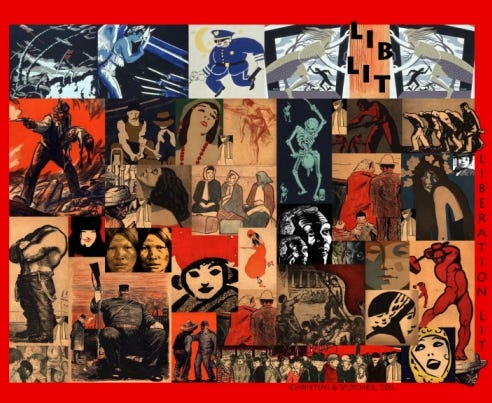
Is there something Evil about Big Culture? Right wing populists certainly think so — often for all the wrong reasons.
What about leftists — what do they see as Evil in Big Culture? Plenty. Going way, way back, but never more problematic and dangerous than today given the omnicidal state of the world.
All the while, liberatory, anti-Empire revolutionary art is often quashed out of existence, frequently under the cover, often fervently believed, of good taste, objectivity, and intellectual or normative impartiality that is anything but.
Such intellectual toxicity is perpetrated unwittingly, so deep can the brainwashing run — it can afflict anyone unconsciously at various times — though the falsehoods are also often propagated as consciously as the most egregious plutocrap, plutocrat propaganda, deceit and denial.
The terminal cultural questions and realities cannot be avoided in an age of nonstop livestream genocide and the ongoing climate collapse that is the ecocide of Earth — occasionally bursting into consciousness as massive hurricanes or wildfire infernos that drown and char people trapped and trying to flee in alternate demonic spectacle. Or choking on smoke across vast regions and many states, reversing all progress on air pollution. Then there’s the continued nuclear threat that can obliterate the world and any hope for decent survival, or any survival, lacking abolition.
Culture, society, and politics, including art in culture, society, and politics determine the fate of the world. So what are the roles of artists, of their art, in helping to determine the fate of the world, of the everyday, and of the great day, the Age?
I’ve written this manifesto six thousand times already over the decades, so why not again? It’s not the first, and it won’t be the last attempt to foreground some of the most vital expressions of culture and life in art that further impel art, consciousness, and action that creates cultural, social, and political change. Something as powerful as art affects a lot in life — creates it or changes it or preserves it for the good or the bad. Here I’ll mix and match and cut and paste and collage from previous commentaries to address romanticism, populism, and other ideologies, while expanding on the topic and emphasizing the novel in particular, an epic form for epic times, amid the imperatives of the age.
Any revolution worthy of its name in culture, in art, in society, in politics will be progressive populist, or bust.
Why? Because we live in a plutocracy-dominated age, where the few rule the many, where the rich rule everyone, where big money controls the guns and bombs and owns the world, buying and selling people and their IDs like the lords and vassals of old bought and sold serfs and land and livestock.
Except people, while treated as serfs and livestock by the plutocracy, are not serfs and livestock. People hate to be treated like cattle and tied down like slaves and bullied, pushed and pulled, hit and demeaned. People hate to be bought and sold by AI, by tech bros, by corporate executives, by high finance, by all these choking tentacles of the plutocracy.
Progressive populists revolt for human rights, for humanity, to live a cooperative and egalitarian life, not a sicko-god-ruled-plutocrat-owned and administered Hellscape of a life.
The revolution in society and art, culture and politics will not be romantic. It will be populist. It had better be. Progressive populist. It already is.
The right-wing fake populist movements and so-called revolutions are mere masked and recursive regurgitations of the tyrannical status quo — militant capitalist and supremacist.
The revolution will be material and spiritual but not capitalist and religious. The revolution will transcend and intervene. It already does. The revolution will be liberatory and healing and fulfilling, and it already is, even while battles are lost and terrible defeats suffered.
The revolutionary will be planetary and planet-wide, as it is. It will not be a singular aesthetic, it will be all-but all-aesthetic and an art.
The revolution will also be un-aesthetic and scientific, in vital ways, and it already is.
Will the revolution be everything all at once to all people? No. The revolution must be a kind of triage, or it will not deserve the name.
Great battles will be fought and great cooperative endeavors will be attempted in all domains in the struggle. And they already are.
The revolution will be content specific, and its forms must follow its content.
The revolution will be televised and not televised, live-streamed and not.
The revolution will be. It already is. As need be.
The Make America Great Again (MAGA) mass hysteria basically means Get Everyone Brainwashed Again (GEBA) into believing a white supremacist plutocrat social order is the height of civilization. Make American Medieval Again (MAMA).
Progressive populists and libertarian socialists have a different idea, one rooted in the enlightenment and human rights and libertarian socialism against tyranny, against militancy, against financial exploitation, against capitalism, and against attacks on vulnerable identities that have been the traditional whipping objects of supremacists everywhere.
There has been some talk among Substack art, literary, and cultural circles in particular of a “new romantic” movement against the rise of the tech billionaire surveillance state AI dystopia, against the cultural and mental policing and the Blakean mind-forged manacling (in “London” the capital of Empire, the poem against Empire, in the time of William Blake), the algorithmic controlling and exploiting by the Big Tech Brotherhood, against would-be unique and prosperous, communal and social individuals seeking the good life in the contemporary world.
But a romantic aesthetic and romantic ideals are too limited. While it’s true that the surveillance state tech bros of high finance and the surveillance state itself are as one with the capitalist plutocracy and the police and military that rule America and much of the world in incredibly dehumanizing and violent, destructive and deadly ways, in no way can merely an aesthetic and an often largely depoliticized notion of “new romanticism” fend off much of any of that, or even create a bubble of culture, wholly vulnerable, amid the daily assaults and depredations of empire.
Romanticism can contribute to the liberatory populist revolution in art, culture, and society but cannot be the whole of it by far.
Especially limited are depoliticized notions of romanticism as laid out in “The Power of Art in the Age of AI,” Megan Gafford’s account of romanticism in a Metropolitan Review article, where more than a dozen renowned romantic artists are referred to as notable historical figures, but there is no mention of Victor Hugo, the greatest literary romantic of them all, and arguably the greatest romantic artist in general. And easily one of the greatest artists of all time. Hugo was incredibly productive over a long life, and his work made great use of romantic imagination in intensely populist ways, even revolutionary, mixing in social and political conscience, and consciousness, epic scope, emotional depth and power with intellectual brilliance, resulting in great impact — socio-political and intellectual, cultural and personal. He also incorporated realism, and modernism far ahead of its time, along with any number of other potent literary modes. We might even say that no individual artist was more maximalist than Victor Hugo. (Though “Shakespeare,” also persecuted by power, may be tough to challenge. Hugo surpasses him, in my view.) Regardless, any overview of romanticism that fails to account for the greatest romantic figure and the politically daring progressive populist nature of such works is ideologically riven and ambling with averted eyes.
There’s a reason (or many reasons) that a lot plaints for and against romantic art elide the name and work of Victor Hugo — he and his work transcend the stereotypical and spectacle-laden and ideologically retrograde notions of romantic art and much else. Hugo’s art cuts deep against the tyrannical and the inhuman in politically, intellectually, and ideologically challenging populist ways. There’s a reason, many, that Hugo was kicked out of polite society and his entire country. The same reasons that other artists who work in similar veins live essentially in internal exile.
Intellectual and political tendencies typical of the establishment disappear the greatest romantic figure and artworks from discussions and movements of romanticism, and long have. Hugo is inconvenient to mention by conventional establishment thinking even though as the pre-eminent figure in romanticism he and his works are essential when considering literary romanticism at all. Hugo’s name and works appear not to have surfaced once in the string of essays by multiple authors about romanticism over the past couple years on Substack, literary romanticism in particular. What kind of discussion of literary romanticism skips the greatest figure and achievements, gutting the great populist thrust of the movement? This is a literary phenomenon that I examined in detail nearly two decades ago in “Fiction Gutted: The Establishment and the Novel,” part of an old and larger story in lit whereby establishment literary ideology typically buries crucial lines of liberatory literature — progressive, populist, socialist, revolutionary — even as the establishment ideologies often pose and proclaim and delude or dupe themselves into thinking they do not — that they are cutting edge, enlightened and progressive.
The revolution in society and art, culture and politics will not be romantic. It will be populist. It had better be. Progressive populist. And it already is.
Only a progressive populist revolution in culture, society, and politics can overthrow the omnicidal establishment and implement human rights based universal programs to heal all. Only a progressive populist revolution can create and cultivate the universal and specific norms and aesthetics that transform, liberate, and illuminate the fully human and the vital human, especially when it cannot otherwise entirely express or enact itself.
America is a homicidal, genocidal, ecocidal country as capitalist empire. It’s complex — there are a lot of good things too, but the militant capitalist police state is run basically as an omnicidal criminal enterprise. The literary establishment in such a country is loathe to assess, produce, or present writers who are plainly willing to engage this reality. Witness the radically depoliticized male stars especially of the American (and Western) lit establishment — depoliticized or marginally politicized — the product of the depoliticized or marginally politicized publishing establishment and administratively cowed intellectual and institutional culture that predominates, much fraudulent and hysterical right-wing blustering to the contrary.
Less of this reality exists farther from the center of empire but often still holds, as the empire’s grip on ideology and resources is in many ways global. It’s not entirely monolithic. And, grimly, it helps when someone can do a favor for their works by conveniently dying, like Roberto Bolaño, such that their works might better live in the fashion the empire desires, even and especially when the works’ politics are not wholly revolutionary by far. The empire is very controlling that way. Though there are some cracks.
The great challenge for left writers in a corrupt culture, for writers with a vivid and vital political pulse, is to break through, break through, always be trying to break through into the consciousness of culture, and into the material reality of the times.
Is the greatest art truly of “beauty” and “originality” and expressive of the “soul” as an all-too-familiar romanticism would have it? Sounds quaint and clichéd, also inscrutable. My wonderfully adorned coffee mug happens to be all that. Doesn’t make it an ultimate work of art.
Romantic art can be intensely progressive, liberatory, revolutionary, socially engaged, and far more powerful than beautiful, far more material than soulful, and far more challenging to power and far more useful to people than necessarily original. All these intense elements and effects of great art can dwarf whatever may be beautiful, original, and soulful about the artwork — those incomplete or arbitrary and nebulous traits that aesthetes especially prefer to uphold as the ultimate aspects of artwork.
Victor Hugo fulfilled but also broke establishment creed to powerful effect and was sent packing for doing so. Other artists through time have done the same, including today. More power to them.
To create their artworks, artists must of course look not only back but around and forward, for as Edmund Wilson noted in “The Historical Interpretation of Literature,” The Triple Thinkers (1940):
The experience of mankind on the earth is always changing as man develops and has to deal with new combinations of elements; and the writer who is to be anything more than an echo of his predecessors must always find expression for something which has never yet been expressed, must master a new set of phenomena which has never yet been mastered….
Artists need to do far more than reinterpret or “misread” the past art and times, however Harold Bloom would have it. It’s necessary for artists to possess a head and heart and gut full of not only the past but the present and what may come even moreso.
The creation of great art is an old and ongoing challenge. Things change, as progressive scholar Vernon Louis Parrington showed a full century ago in 1927 in his groundbreaking or at least formative Main Currents in American Thought: An Interpretation of American Literature from the Beginnings to 1920:
This much is clear: an industrialized society is reshaping the psychology fashioned by an agrarian world; the passion for liberty is lessening and the individual, in the presence of creature comforts, is being dwarfed; the drift of centralization is shaping its inevitable tyrannies to bind us with. Whether the quick concern for human rights, that was the novel bequest of our fathers who had drunk of the waters of French romantic faith, will be carried over into the future, to unhorse the machine that now rides men and to leaven the sodden mass that is industrial America, is a question to which the gods as yet have given no answer. Yet it is not without hope that intelligent America is in revolt. The artist is in revolt, the intellectual is in revolt, the conscience of America is in revolt….
By now, conditions of life change extremely fast even as literature stagnates, in the paralytic grip of the plutocracy. As far back as 1987, Maxine Hong Kingston commented in the progressive Mother Jones magazine, “The Novel’s Next Step”:
I’m going to give you a head start on the book that somebody ought to be working on. The hands of the clock are minutes away from nuclear midnight. And I am slow, each book taking me longer to write… So let me set down what has to be done, and maybe hurry creation, which is about two steps ahead of destruction…. All the writer has to do is make Wittman [hero of her novel, Tripmaster Monkey] grow up, and Huck Finn and Holden Caulfield will grow up. We need a sequel to adolescence—an idea of the humane beings that we may become. And the world will have a sequel…. The dream of the great American novel is past. We need to write the Global novel…. The danger is that the Global novel has to imitate chaos: loaded guns, bombs, leaking boats, broken-down civilizations, a hole in the sky, broken English, people who refuse connections with others…. How to stretch the novel to comprehend our times—no guarantees of inherent or eventual order—without having it fall apart? How to integrate the surreal, society, our psyches?
The Empire is always intent upon disappearing literature that exposes the depredations of plutocracy directly, explicitly. Capitalist culture does everything it can to destroy progressive populist let alone revolutionary consciousness, culture, art, politics, and action. The mental and physical attacks against the public are nonstop. The need to resist could not be greater as novelist and brave activist Arundhati Roy in War Talk “Confronting Empire” notes pointedly:
Our strategy should be not only to confront empire, but to lay siege to it. To deprive it of oxygen. To shame it. To mock it. With our art, our music, our literature, our stubbornness, our joy, our brilliance, our sheer relentlessness – and our ability to tell our stories. Stories that are different from the ones we’re being brainwashed to believe.
To overthrow the deathly tyranny of empire — whether economic, political, military, or cultural — nothing is more imperative today in art, and elsewhere, given this genocidal, ecocidal, omnicidal age — from which no “souls” may survive to imagine or be imagined, unless anti-Empire and liberatory intervention in life is successful.
Beauty, originality, “soul” — that’s only part of art, whether artform or artwork. Such features are only a sampling of core elements in form, content, and effects of art.
Meanwhile, vital art can be but is not always going to be even remotely romantic.
Highly accomplished and effective indispensable art carries a lot more on its plate than all that. Seemingly countless networks of art struggle to come to grips with this reality, or work forcefully to distort and evade it.
Today it’s in the most penetrating of the people’s media where you find much of the greatest signs of the artistic life of the age. You find the most freedom there, the most insight, great achievement, the most heart and guts, typically by far. Notably the same often holds true for social, political, and intellectual commentary as well.
Speech is political. The verbal is political. And social and cultural. And ideological. Not least when rendered aesthetically in some artform as an artwork.
Just as liberatory universal goods are needed to literally heal the people of the country, and world — universal health care, basic income, college, living wages, child care, vacation, housing, healthy food and environment, and on and on, universal goods that come only wholly from the left wing, not from liberals and conservatives who fight against the people on behalf of the plutocracy nonstop — so does a liberatory populist art need to flourish universally among the people. There can be and should be other kinds of art than the populist of course, but there must be a liberatory populist art that predominates to both save and sustain life itself, a liberatory culture, society, politics — anti-Empire, anti-tyranny, anti-plutocracy. Not fake populist, not tyrannical populist, not supremacist populist but progressive, revolutionary, liberatory. Whatever the aesthetic — romantic, realist, satiric, ironic, comedic, tragic, epic, minimalist, maximalist, you-name-it — the imperative revolution today as always against inequality and tyranny, in art and culture, society and politics, is progressive populist. It’s liberatory.
People are conditioned and encouraged nonstop to think and believe otherwise by those who exploit and profiteer. Especially in a plutocratic status quo that is highly politicized and exploitative, the greatest art will rise to the occasion of the people’s defense and liberty. One cannot escape the intensely politicized world. One can only either engage it or ignore it. The greatest art, most human, will engage it. As it can and it must.
Most Human — great title for a novel. Assign the title to multiple novelists and you would get wildly different novels. Assign Most Human: A Populist Novel and you would still get wildly different novels, you should. The point is, there is nothing necessarily prescriptive nor staid about ideology in literature. It’s inescapable. Best to be conscious of it and maximize it.
Some will call it propaganda and dismiss it. Some will call it political and dismiss it. Some will call it wrong form and dismiss it. Some will insult it, decry it, belittle it, fear it, loathe it, and feel threatened by it. Others will be appreciative and inspired. Some may act, think, grow, live anew. The authors too.
Our fundamental contemporary state of being, the major event of contemporary life, is the ongoing sixth mass extinction, the Anthropocene — the terminal glide path of all life that we are currently riding and driving, some more quickly and forcefully, desperately and fatefully than others. We live in endlessly perilous and brutal times — no matter how domestic our lives, or how international — and if we are not so aware in our stories increasingly then we risk fiddling while Earth burns, while despair, disease, aggression, genocide, ecocide, omnicide condemn us all, and all life. If Earth goes up in flames, then none of the social or personal justice issues matter. It’s over. This is the event of our lives and of all life. That doesn’t mean don’t focus on infinite kinds of justice and causes, high concepts, myriad life cases, and other vital issues and realms, it means put things in great perspective. It’s all-hands-on-deck time, not least in the capital country of rapacious and deadly Empire, America, which is increasingly embroiled in a kind of simmering civil war that masks the wholesale depredations of Empire, the plutocracy, against all the people and the planet.
This is what the big social or political novel or any truly big ambitious novel is all about — or should be about because it needs to be if it is to explore and reveal the full human condition and its possibilities, and interact with it and impact it in imperative ways. The civil wars of gender politics and other forms of identity politics rage while the Empire’s war on the People and Earth consumes all and stokes the identity wars to great profit. Is there only one war that should be fought, one story that should be told? No, there are many but the fact is that all stories now are contained within the great war for species and planetary survival.
And so the imperative revolution in art and everything else today is progressive populist or bust — across all aesthetics and artforms and artworks. So what is libertarian socialist and revolutionary art exactly? That’s what needs to be found out. Tough to do so while its efforts are being quashed by the reigning ideologies and institutions. Wittingly and unwittingly pathetic, retrograde, and vile as they are. If you think there is nothing pathetic, retrograde, and vile about, say, Disney in either what it creates or excludes, think again. Of course, Disney art and institutional productions can have some good in them. A lot of ideologies and institutions have some good in them, as they are complex. And yet, in the empire, in the plutocracy, all the prevailing institutions and ideologies — the plutocrat establishment and fellow travelers — manifest in a wide variety of ways as bigoted, supremacist, and tyrannical — core inherent features of the system.
Wouldn’t it be good to propagate an ideology of art and culture, society and politics that rejects and counters all that — explicitly and directly? Wouldn’t that be fully human? Almost, you know, romantic — but far from that limited. The satiric bite, for one, is too delicious and effective to forgo. And the comedic call-out. The tragic insight. The epic sweep. The Utopian ideal. The realist condemnation and exaltation. The speculative jolt. The fantastical freedom.
Don’t be limited by aesthetics. Do enhance your content. Make it revolutionary. Or at least progressive populist in pitched battle with the supremacists and other tyrants and tyrannies of material, mind, and emotion. Make it art or break it art. Revolutionize it for a better today and a livable tomorrow.
POST VIA LIBERATION LIT
 A Practical Policy