Contents, Selections, Links
POST VIA LIBERATION LIT
Fifteen years ago that seem like fifty, Andre Vltchek and I DIY-published a massive Liberation Lit anthology. We put together 830 pages, each double-columned — so a 1,660 page equivalent volume at 467,000 words.
We received gracious and keen commentary on the anthology from Adrienne Rich and Terry Eagleton. The compendium contains a rare short story from Arundhati Roy and great contributions from many others around the world — from people in modern-day dungeons to the hallowed halls of Academia and everywhere in between — from Africa, Asia, Europe, the Americas, and Australia.
For all its heft, the anthology is a partial and incomplete attempt to coalesce in one place a global sense of what might be meant by liberation lit, or liberatory lit.
“What’s Lib Lit? – Library, map, lens, scalpel, compost, chisel, textbook, excavation: voices, images, wrestling, contradicting, confirming, the matter of resistant art and practise.” –Adrienne Rich
“The relation between literature and liberation runs very deep. From Blake to Ginsberg, Shelley to Sartre, literature has often enough served as an image of creativity from which any authentic politics has to learn. In this sense, all artistic work has an implicit utopian dimension; but the pieces in this splendid anthology are unique in explicitly highlighting this concealed underside of literary art, showing us how to hope and desire otherwise. In a darkening political world, this book deserves a wide readership, as it sheds a light on the present from a possible future.” –Terry Eagleton
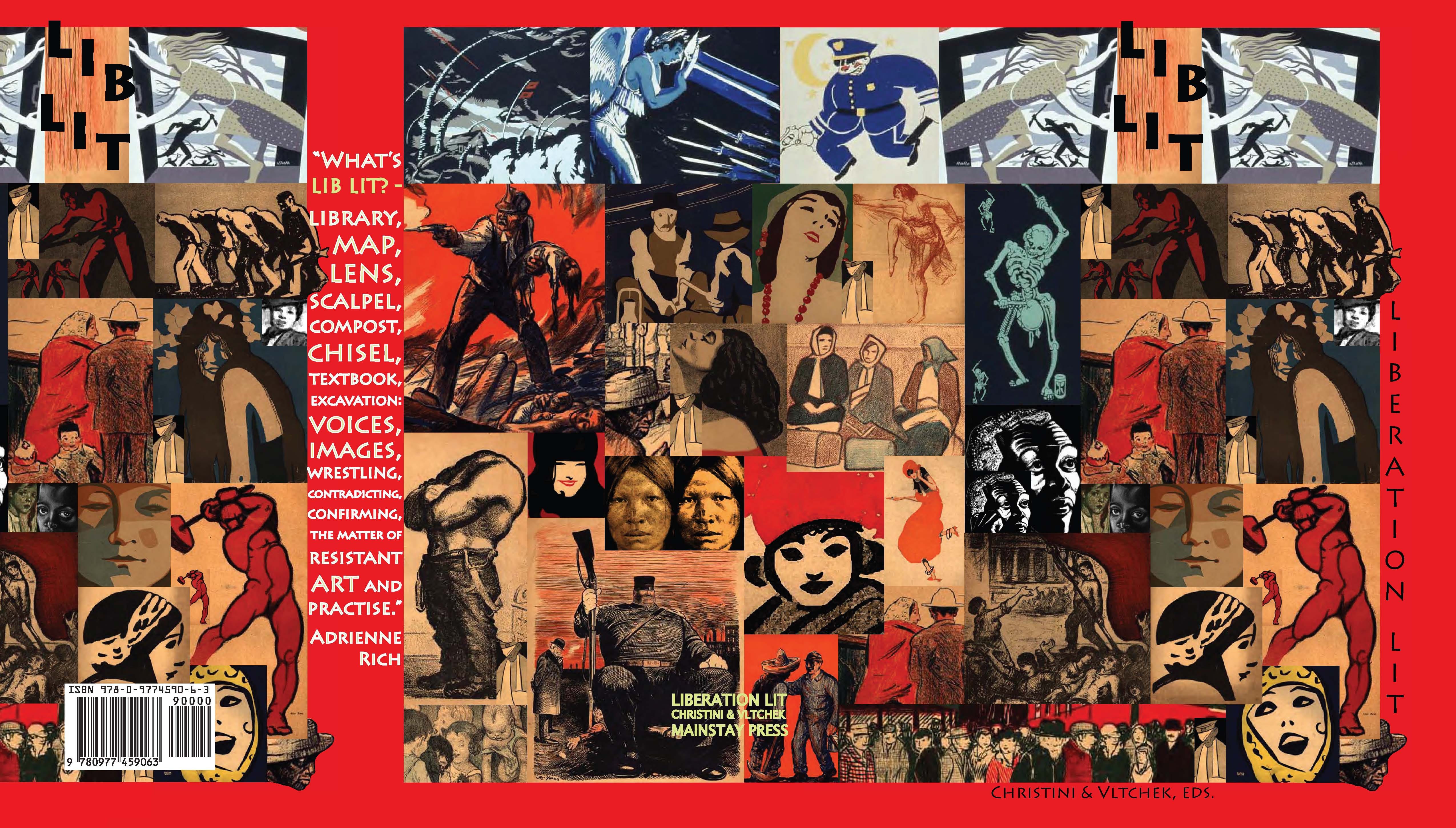
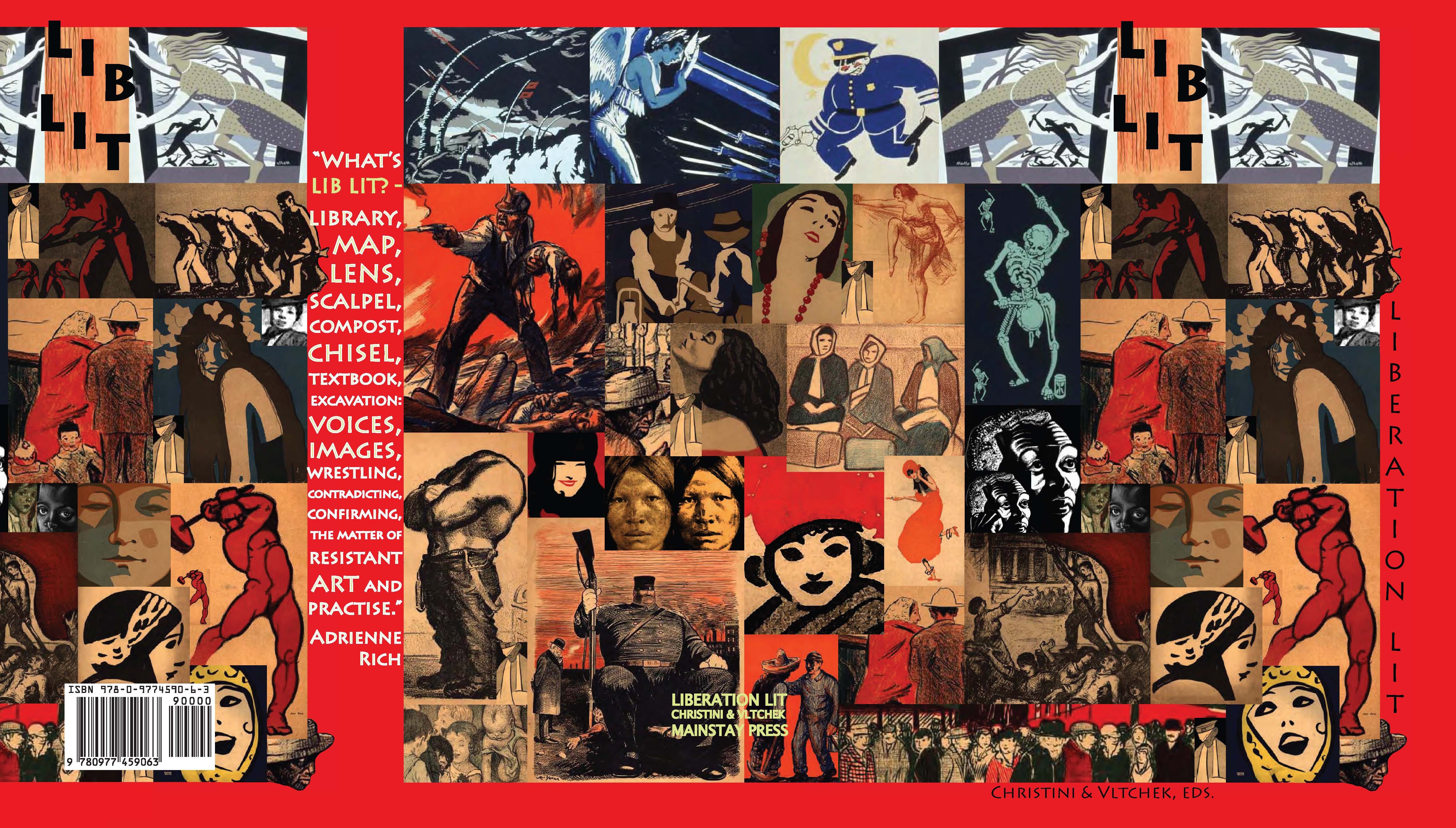
The cover collage of Liberation Lit originates mainly from illustrations of The Masses magazine from early last century, and posters from the WPA Federal Theater Project.
Included below from the anthology are very short pieces of fiction from Andre and myself, followed by Arundhati Roy’s story and the complete Liberation Lit Table of Contents that contains links to a number of other pieces online.
from Life on Dearth
The Bush Plan to Abolish America
Tony Christini
President Bush announced today that he expects to find a congressional sponsor for a bill that would abolish Congress as it is currently known. The Old Congress would be replaced by the New Congress which would consist of two and only two Senators, one from the North and one from the South, and three and only three Representatives – one from the North and one from the South and one from the Middle of the country, to break ties. In the Senate, per tradition, the (full of) Vice President would continue to break any tie between the two new Senators.
The President feels sure that such a duly elected and duly simplified Congress will be able to vastly reduce unseemly partisanship while greatly increasing the efficiency and effectiveness of its operations. “The people are tired of PR,” the President said. “They are sick and tired of political races and Congressional bickering. Let’s end this failed experiment in democracy now. Let’s give them what is good for the country.”
The Administration’s Press Secretary denied that the Bush Plan, as the proposal has come to be known, has anything to do with the persistent rock bottom approval ratings of either the President or Congress. “No matter how popular the President may be or may not be he still wants to get rid of Congress,” said the Press Secretary, in what is widely seen as a rare moment of candor.
Republican legislators, in the name of cutting government spending, seem to be generally for the plan. In any event, there are rumors that each Congressional seat will be privatized, transformed into independent lobbying corporations. Democrats have said they are inclined to go along with the plan so as not to appear partisan. “Plus,” one leading congressional Democrat concluded, “if the plan fails and the country turns into a total right-wing fascist dictatorship, we will all know who is to blame.”
There have been some murmurs in corporate circles that such a plan may be seen as unconstitutional by some, but there is every expectation that the newest Supreme Court justices Alito and Roberts will decide in the President’s favor. “Besides,” one of the old Supreme Court justices has been overheard to say, “we brought the Good Ol’ Boy King into power, and we can damn well keep him there.”
At this point, the rest of the country has not been heard from.
Stocks are way up on word of the potential congressional realignment, and President Bush was photographed at his ranch in Texas, giving his by now customary thumbs up to visitors Rumsfeld, Rice, and Cheney – and all the regular Cabinet gang. Meanwhile, a few miles down the road Cindy Sheehan was being told where to go by a Presidential security detail as Sheehan and supporters were setting up camp again to protest the President’s war and to honor her son Casey, killed in action in Iraq. At last word, Sheehan and the camp appeared to be driving in tent poles and otherwise digging in for the night.
from Point of No Return
Storyteller and East Timor
Andre Vltchek
I stood on the deck of Pelni, an Indonesian ocean liner leaving Dili, East Timor. It was almost dark. High waves were sending foam over the deck. I kept cleaning my glasses.
A woman looked my way, standing motionless, close to the railing. Her husband was washing his feet, ready to enter a small Muslim praying room. I looked back at her, unable to determine where she was from.
I felt lucky to be alive; to be on this ship which was taking me away from East Timor. I carried several used rolls of film in my small equipment bag, two Leicas and five pairs of dirty underwear.
I had seen enough; more than I had expected to see and I felt exhausted, outraged, paralyzed. I had to think about what I had witnessed, I had to think how to begin to write the story, but my brain was refusing to function. I felt empty and sick.
The woman was wearing a long Javanese dress, falling almost to her feet. Her fingers were long and slender, ink-black hair covered her shoulders.
I had no idea why she was looking at me with those huge black eyes. There was no smile on her lips, no expression of friendliness. It was as if she were waiting for something, as if she were trying to read something written on my face.
A few minutes later her husband went to pray. He said nothing to her; he just left her standing on the deck, alone.
Almost immediately, she approached me.
“You saw…?”
“I don’t understand,” I said.
“You saw it?”
“Your husband is an official,” I said. “He is from Java, isn’t he?”
“Yes,” she said. “Don’t judge me, please. You don’t know anything.”
“Where are you from?”
“From here. From Dili.”
“I enjoyed my visit very much,” I said. “Wonderful place. Very beautiful scenery and friendly people.”
“Stop it!” she screamed, but the sound of the waves muted her voice. “Don’t torture me, please. You saw everything. You know…”
“What do you want from me?” I asked.
“Nothing. I just want you to tell the truth. To say what you saw.”
“Nobody cares,” I said. “Nobody gives a damn.”
“Nobody?”
“I don’t know. A few people, maybe.”
“But you care…. You came here,” she whispered, desperately.
“Yes,” I said. “But it doesn’t count. I go to many places. Nobody has any influence on me, but in turn, I have no influence on anybody.”
“But you have to…”
“You speak good English,” I said.
“Thank you. I studied English for years. I wanted to leave. But that doesn’t matter. You saw…”
“Yes,” I said. “They raped the whole village; from children to grandmothers. They carved obscenities into women’s bodies; with the knives. They burned their clitoris with cigarette butts. They cut off ears from several men; they killed others. Just for fun. Should I go on? It gets worse.”
“I know all this,” she said. “One third of the East Timorese are dead. Since the invasion.”
“That’s about the correct estimate.”
“They don’t know it in Java.”
“They don’t?” I said. “They prefer not to know. Maybe they don’t know anything about 1965 and about Aceh and Papua and hell knows what.”
“They pray,” she nodded toward the room in which her husband disappeared. “They pray because they are scared. Because otherwise the whole nation would have to howl in horror from its own guilt. They need it to be blasted loud, every day, for hours, so they can’t hear their own hearts. They need it to overpower their own consciousness. Their children are being orphaned by the millions; their children prostitute themselves and beg. Their cities are like purgatories, but they still don’t see. They prefer not to see. They are deaf and mute.”
“He is going to come out, soon. He will not be happy to see you talking to me.”
“Yes,” she said. “I will find you later.”
“It may not be wise.”
“I have to.”
She moved away. I sat on the bench, opening another pack of salty crackers. The bench had to be my home for two days. The ship was sailing to Alor and than to Maumere in Flores. All the private cabins were taken by government officials. The alternative would be one of the overcrowded, dark, communal rooms, packed with broken chairs, people and plastic bags. I had tried to enter one, but was immediately repelled by a powerful stench. It smelled like the entire modern Indonesia – of unwashed bodies, repulsive spicy food, dirt, illness and decay. I preferred to stay on deck, ready to be exposed to the strong wind and waves, but also to fresh air.
I had a ten pack of salty crackers and five liters of bottled water to keep me company. And I still had two packs of cigarettes left in my bag.
Her husband appeared. He said nothing; just nodded at her and she followed him upstairs, a few steps behind, to one of the cabins. She never looked back at me.
As the lights from the shore disappeared, total darkness embraced the ship. The sky was overcast and I saw no stars and no moon above us. The waves were increasing in size, but I felt fine, just tired and still absolutely empty.
Somebody was throwing up from the upper deck. Puke was carried by the wind and parts of it hit my face. I poured some water over my head.
People kept coming.
“Hey mister! Where are you from? Hey, how much money you make? Where are you going? Indonesia, bagus!?”
“Bagus!” I would respond. Then some puke from above hit my face again. Men laughed. They came to piss on the deck; the toilets had covered an entire floor below deck with urine and excrement up to the ankles. “Bagus!” I would repeat.
She came back later, almost at midnight.
“He is asleep,” she said. “I don’t have much time. He sometimes wakes up.”
I said nothing.
“Do you scorn me?”
“No,” I said. “For heaven’s sake, of course I don’t.”
“I scorn myself, sometimes. But most of the time I am dreaming about being strong enough to kill him. It helps.”
“I understand,” I said. “How many years have you been married?”
“I don’t remember. I don’t want to remember. Five years, maybe. Or maybe longer. He took me when I was nineteen.”
“Took you?”
“Yes. One day I came back to East Timor from Bandung. I was studying there, at the university. I stayed in my house for two weeks. They raided our house, very late at night. They killed my older brother and they took away my sister. Then he came back, for me. He had his way with me for two days and three nights. He never shared me with the others. He did things to me, you know…. I don’t want to say it…. Then he said I would soon marry him. I said I would kill myself but he replied that if I did, who knew what would happen to my mother and my younger brother.”
“I’m sorry,” I said.
“Then I had to convert. He took me to Java. I began to live with his family; he is hardly at home. They torture me, you know…. Not my body, but they still do, in their own way. I have two children.”
“Two children…” I repeated.
“I wish they would die,” she said. “They are his children, not mine.”
“Damn,” I said. I gave her my card. “Run away,” I said.
“There is no place to run,” she said. “This is Indonesia. If you run away and you can’t return to your own home, you end up as a prostitute or maid, or both. If you are lucky.”
“I’ll try,” I said. “I will try to write, I promise. It’s true that nobody cares, but I’ll really try.”
“Thank you,” she said.
“I wish I could do more.”
“You can’t.”
“Do you have a passport?”
“No. I have nothing. I’m just his slave.”
“Damn,” I said. “I really hate this country.”
“So do I,” she said. “But I have never been anywhere else. Almost no one from here has been anywhere else. And those who travel are already programmed. They see but they pretend that they don’t see. They teach them how to be proud to be Indonesians. Instead of telling us how it is outside, they come back and say that they are happy to be back in this country. We never learn anything from them. But I hope there is a world outside. And I hope I will see it one day. And I will never come back, no matter what. They killed so many people. There are so many people who are still alive but dead inside.”
“You will see it; you will see the world outside,” I said. “But maybe it’s not as pretty as you imagine.”
“But it has to be better than this…”
“Yes,” I said. “Almost anything is better.”
“I knew it.”
“And one day, your country will be free.”
“I have almost nobody left, there. Please tell them, please tell the world outside what they have done to us.”
“I will,” I said. “I swear I will. I will always remember you.”
I was too exhausted after not sleeping for two nights. I wasn’t sure what I was saying, but I kept speaking, anyway.
She made a cross with her fingers before leaving me. “May Jesus protect you,” she said. I followed her with my eyes. I wasn’t sure how much more of this I could take. She had passed her pain to me and now I had to carry it inside; I had to live with it for the rest of my life. With her pain and with the pain of so many others.
I ran after her, I stopped her, I took her hand, I pressed her with all the strength against me, I felt every inch of her fragile body responding, I begged her silently for forgiveness. I was apologizing for my country which had allowed this to happen, for humanity and for all of us, storytellers, who had failed her as well as those countless millions like her, all over the world.
published in Manifesta 7
a European Art Biennial, 2008
The Briefing
Arundhati Roy
My greetings. I’m sorry I’m not here with you today but perhaps it’s just as well. In times such as these, it’s best not to reveal ourselves completely, not even to each other.
If you step over the line and into the circle, you may be able to hear better. Mind the chalk on your shoes.
I know many of you have traveled great distances to be here. Have you seen all there is to see? The pillbox batteries, the ovens, the ammunition depots with cavity-floors? Did you visit the workers’ mass grave? Have you studied the plans carefully? Would you say that it’s beautiful, this fort? They say it sits astride the mountains like a defiant lion. I confess I’ve never seen it. The guide-book says it wasn’t built for beauty. But beauty can arrive uninvited can it not? It can fall upon things unexpectedly, like sunlight stealing through a chink in the curtains. Ah, but then this is the Fort with no chinks in its curtains, the Fort that has never been attacked. Does this mean its forbidding walls have thwarted even Beauty and sent it on its way?
Beauty. We could go on about it all day and all night long. What is it? What is it not? Who has the right to decide? Who are the world’s real curators, or should we say the real world’s curators? What is the real world? Are things we cannot imagine, measure, analyze, represent and reproduce real? Do they exist? Do they live in the recesses of our minds in a Fort that has never been attacked? When our imaginations fail, will the world fail too? How will we ever know?
How big is it, this Fort that may or may not be beautiful? They say it is the biggest fort ever built in the high mountains. Gigantic, you say? Gigantic makes things a little difficult for us. Shall we begin by mapping its vulnerabilities? Even though it has never been attacked (or so they say) think of how its creators must have lived and re-lived the idea of being attacked. They must have waited to be at-tacked. They must have dreamt of being attacked. They must have placed themselves in the minds and hearts of their enemies until they could barely tell themselves apart from those they feared so deeply. Until they no longer knew the difference between terror and desire. And then, from that knothole of tormented love, they must have imagined attacks from every conceivable direction with such precision and cunning as to render them almost real. How else could they have built a fortification like this? Fear must have shaped it; dread must be embedded in its very grain. Is that what this fort really is? A fragile testament to trepidation, to apprehension, to an imagination under siege?
It was built – and I quote its chief chronicler – to store everything that ought to be defended at all costs. Unquote. That’s saying something. What did they store here comrades? What did they defend?
Weapons. Gold. Civilization itself. Or so the guide book says.
And now, in Europe’s time of peace and plenty, it is being used to showcase the transcendent pur-pose, or, if you wish, the sublime purposelessness, of civilization’s highest aspiration: Art. These days, I’m told, Art is Gold.
I hope you have bought the catalogue. You must. For appearances’ sake at least.
As you know, the chances are that there’s gold in this Fort. Real gold. Hidden gold. Most of it has been removed, some of it stolen, but a good amount is said to still remain. Everyone’s looking for it, knocking on walls, digging up graves. Their urgency must be palpable to you.
They know there’s gold in the Fort. They also know there’s no snow on the mountains. They want the gold to buy some snow.
Those of you who are from here – you must know about the Snow Wars. Those of you who aren’t, listen carefully. It is vital that you under-stand the texture and fabric of the place you have chosen for your mission.
Since the winters have grown warmer here, there are fewer ‘snowmaking’ days and as a result there’s not enough snow to cover the ski-slopes. Most ski-slopes can no longer be classified as ‘snow-reliable’. At a recent press conference – perhaps you’ve read the reports – Werner Voltron, President of the Association of Ski-instructors said, “The future, I think is black. Completely black,” [Scattered applause that sounds as though its coming from the back of the audience. Barely discernable murmurs of Bravo! Viva! Wah! Wah! Yeah Brother!] No no no…comrades, comrades …you misunderstand. Mr Voltron was not referring to the Rise of the Black Nation. By Black he meant ominous, ruinous, hopeless, catastrophic, and bleak. He said that every one degree Celsius increase in winter temperatures spells doom for almost one hundred ski-resorts. That, as you can imagine, is a lot of jobs and money.
Not everybody is as pessimistic as Mr Voltron. Take the example of Guenther Holzhausen CEO of MountainWhite, a new branded snow product, popularly known as Hot Snow (because it can be manufactured at two to three degrees Celsius above the normal temperature). Mr Holzhausen said – and I’ll read this out to you – “The changing climate is a great opportunity for the Alps. The extremely high temperatures and rising sea levels brought about by global warming will be bad for seaside tourism. Ten years from now people usually headed for the Mediterranean will be coming to the comparatively cooler Alps for skiing holidays. It is our responsibility; indeed our duty to guarantee snow of the highest quality. MountainWhite guarantees dense, evenly spread snow which skiers will find is far superior to natural snow.” Unquote.
MountainWhite snow, comrades, like most artificial snows, is made from a protein located in the membrane of a bacterium called Pseudomonas syringae. What sets it apart from other snows, is that in order to prevent the spread of disease and other pathogenic hazards, MountainWhite guarantees that the water it uses to generate snow for skiing is of the highest quality, sourced directly from drinking water networks. “You can bottle our ski-slopes and drink them!” Guenther Holzhausen is known to have once boasted. [Some restless angry murmuring on the sound track] I understand … But calm your anger. It will only blur your vision and blunt your purpose.
To generate artificial snow, nucleated, treated water is shot out of high-pressure power-intensive snow cannons at high speed. When the snow is ready it is stacked in mounds called whales. The snow whales are groomed, tilled and fluffed before the snow is evenly spread on slopes that have been shaved of imperfections and natural rock formations. The soil is covered with a thick layer of fertilizer to keep the soil cool and insulate it from the warmth generated by Hot Snow. Most ski resorts use artificial snow now. Almost every resort has a cannon. Every canon has a brand. Every brand is at war. Every war is an opportunity.
If you want to ski on – or at least see – natural snow, you’ll have to go further, up to the glaciers that are wrapped in giant sheets of plastic foil to protect them from the summer heat and prevent them from shrinking. I don’t know how natural that is though – a glacier wrapped in foil. You might feel as though you’re skiing on an old sandwich. Worth a try I suppose. I wouldn’t know, I don’t ski. The Foil Wars are a form of high altitude combat – not the kind that some of you are trained for [chuckles]. They are separate, though not entirely unconnected to the Snow Wars.
In the Snow Wars, MountainWhite’s only serious adversary is Scent n’ Sparkle, a new product introduced by Peter Holzhausen, who, if you will pardon me for gossiping, is Guenther Holzhausen’s brother. Real brother. Their wives are sisters. [A murmur]. What’s that? Yes… real brothers married to real sisters. The families are both from Salzburg.
In addition to the all the advantages of MountainWhite, Scent n’ Sparkle promises whiter, brighter snow with a fragrance. At a price of course. Scent n’ Sparkle comes in three aromas, Vanilla, Pine and Evergreen. It promises to satisfy tourists’ nostalgic yearning for old-fashioned holidays. Scent n’ Sparkle is a boutique product poised to storm the mass market, or so the pundits say, because it is a product with vision, and an eye to the future. Scented snow anticipates the effects that the global migration of trees and forests will have on the tourism industry. [Murmur] Yes. I did say tree migration.
Did any of you read Macbeth in school? Do you remember what the witches on the heath said to him? “Macbeth shall never vanquished be, until Great Burnam Wood to high Dunsinane Hill shall come against him?”
Do you remember what he said to them?
[A voice from the audience somewhere at the back, says, “That will never be. Who can impress the forest, bid the tree unfix his earthbound root?”]
Ha! Excellent. But Macbeth was dead wrong. Trees have unfixed their earthbound roots and are on the move. They’re migrating from their devastated homes in the hope of a better life. Like people. Tropical palms are moving up into the lower Alps. Evergreens are climbing to higher altitudes in search of a colder climate. On the ski-slopes, under the damp carpets of Hot Snow, in the warm, fertilizer-coated soil, stowaway seeds of new hothouse plants are germinating. Perhaps soon there’ll be fruit trees and vineyards and olive groves in the high mountains.
When the trees migrate, birds and insects, wasps, bees, butterflies, bats and other pollinators will have to move with them. Will they be able to adapt to their new surrounding? Robins have already arrived in Alaska. Alaskan caribou plagued by mosquitoes are moving to higher altitudes where they don’t have enough food to eat. Mosquitoes carrying malaria are sweeping through the Lower Alps.
I wonder how this Fort that was built to withstand heavy artillery fire will mount a defense against an army of mosquitoes.
The Snow Wars have spread to the plains. MountainWhite now dominates the snow market in Dubai and Saudi Arabia. It is lobbying in India and China, with some success, for dam construction projects dedicated entirely to snow cannons for all-season ski-resorts. It has entered the Dutch market for dyke reinforcement and for sea-homes built on floating raft foundations, so that when the sea levels rise and the dykes are finally breached and Holland drifts into the ocean, MountainWhite can harness the rising tide and turn it into gold. Never fear MountainWhite is here! works just as well in the flatlands. Scent n’ Sparkle has diversified too. It owns a popular TV channel and controlling shares in a company that makes – as well as defuses – landmines. Perhaps their new batch will be scented – strawberry, cranberry, jojoba – in order to attract animals and birds as well as children. Other than snow and landmines, Scent n’ Sparkle also retails mass market, battery operated, prosthetic limbs in standard sizes for Central Asia and Africa. It is at the forefront of the campaign for Corporate Social Responsibility and is funding a chain of excellently appointed corporate orphanages and NGOs in Afghanistan which some of you are familiar with. Recently it has put in a tender for the dredging and cleaning of lakes and rivers in Austria and Italy that have once again grown toxic from the residue of fertilizer and artificial snowmelt.
Even here, at the top of the world, residue is no longer the past. It is the future. At least some of us have learned over the years to live like rats in the ruins of other peoples’ greed. We have learned to fashion weapons from nothing at all. We know how to use them. These are our combat skills.
Comrades, the stone lion in the mountains has begun to weaken. The Fort that has never been attacked has laid siege to itself. It is time for us to make our move. Time to replace the noisy, undirected spray of machine-gun fire with the cold precision of an assassin’s bullet. Choose your targets carefully.
When the stone lion’s stone bones have been interred in this, our wounded, poisoned earth, when the Fort That Has Never Been Attacked has been reduced to rubble and when the dust from the rubble has settled, who knows, perhaps it will snow again.
That is all I have to say. You may disperse now. Commit your instructions to memory. Go well, comrades, leave no footprints. Until we meet again, godspeed, khuda hafiz and keep your powder dry.
[Shuffle of footsteps leaving. Fading away.]
LIBERATION LIT
prologue / fiction / visuals / poetry / US in Iraq / prison / Kenya
essays & interviews & blogs / collage of criticism / contributors
PROLOGUE
Tony Christini and Andre Vltchek 10
Liberatory Literature – Notes on the anthology
V. F. Calverton (George Goetz) A View of Liberatory Art 11
LIBERATORY FICTION
Adetokunbo Abiola 15
The Militants; Lizy; The Forgotten Inmate
Laura Carlsen 28
The Slow Slide to Barbarity
Tony Christini 30
Life on Dearth; Youthtopia (excerpt)
Joe Emersberger 70
Segundo’s Revenge; The Publisher; Dave the Prophet; Wovokia;
Playing Giovanitti
Shelley Ettinger 98
Herb and Leo Are at It Again
Ishimure Michiko 105
Lake of Heaven (excerpt)
Shabnam Nadiya 112
Girl in the Rain
Arundhati Roy 118
The Briefing
Paul Street 121
Dead Man Talking; Leading Democrats: “Expropriate the
Expropriators”; A Message From The American Corporate
Plutocracy
Joseph Veramu 133
The Toothache; The Television Footage
Andre Vltchek 137
The Weekly Globe; Storyteller and East Timor;
The Color of God; Conversations with James; Soledad
Buff Whitman-Bradley 171
Satires – Lebanese grandmother praises Israel; Israel bombs
Vermont; Where are the conservatives?; Bush Fights Global
Warming; The war on terrorism takes a new turn; Making a
killing from global warming; The future is now: Ask Mr. History
Jenny Ruth Yasi 179
Between Boston and Burma
LIBERATORY FICTION PAST
Ernest Callenbach – Ecotopia (excerpt) 187
Claude McKay – Banjo (excerpts) 189
Upton Sinclair – The Jungle (excerpt) 194
Mark Twain – The War Prayer 199
Stella Miles Franklin – My Career Goes Bung (excerpt) 201
Charles Chesnutt – The Marrow of Tradition (excerpt) 217
Charlotte Perkins Gilman – The Yellow Wallpaper 231
Victor Hugo – Les Misérables (excerpt) 240
Harriet Beecher Stowe – Uncle Tom’s Cabin (excerpt) 247
Jonathan Swift – A Modest Proposal (excerpt) 252
LIBERATORY VISUALS
Mark Vallen 259
Fuses – Revolutionary silkscreen
Theodore A. Harris 260
Drowning in Bones and Flames – Partisan collage
Carol Simpson 261
Cartoons – Life in Corporate Utopia
Marina Weidemann 270
Cartoons – US on a rampage
Stephanie McMillan 273
Cartoons – Against corporate-state conquest in Iraq and elsewhere
Kim Alphandary 276
Nigerian Freedom Fighters; Zapatista – Revolution in charcoal
John Sloan 280
Ludlow, Colorado (1914) – Coal miners and their families attacked
Andre Vltchek 281
Photographs of Venezuela – People, art, and social change
LIBERATORY POETRY
Alaa Kadhim al-Jabiri 285
The Play
Tony Christini 286
News From Little Rock
Kim Jensen 289
Ode to Man and War’s End
Marge Piercy 290
Film can reverse but not time
Margaret Randall 291
What I Tell the Young When They Ask
Andrew Rihn 293
Dozers
Adrienne Rich 294
Emergency Clinic
Buff Whitman-Bradley 295
Four Poems – In kindergarten I wore bright yellow socks; DeSoto Bend; We’re gonna shoot those looters on sight; Who says they
bungled it?
Mickey Z 306
A Cycle
Mwandawiro Mghanga 307
Voice Of Struggle: Poems From Prison In Kenya
LIBERATORY FOCUS – US in IRAQ
Appalachian Author 344
Please Attack Appalachia
Tony Christini 345
Homefront (excerpt); John Doe Dimslow and the IED;
The Incorporation of Oila; We, The Children of Iraq
Joe Emersberger 358
Dave the Prophet
Dahr Jamail 363
Iraq on My Mind – Thousands of Stories to Tell and No One to Listen
Cindy Sheehan 367
Once Upon a Time
Buff Whitman-Bradley 368
Realpolitik, Street Theater M19 ’08; The last child in Iraq died
today; News of war; Freshly shelled peas; Shock and Awe haiku; The United States of Torture; Property Damage; To the children of Iraq: Nobody ever said life was fair; Weapons of mass destruction; Slouching toward Baghdad
LIBERATORY FOCUS – PRISON
Guest Editors: Katy Ryan and Bill Ryan
Work by Prisoners:
Poetry
Ryan Kirkpatrick – Loneliness 384
Donald McDonald – Jailhouse New 384
Jonathan Bartlett – The Ballad of a Dead Beat Dad 385
Angel Torres – The World We Make 386
a state of Illinois prisoner – A Poem 386
David A. Smith – Concrete and Iron City 387
a prisoner – “Safe?!”; T.A.M.M.S.; America’s Supermaximums 388
Fiction
Joe Dole – If Only 391
Lockdown Prison Heart (excerpts) – Renaldo Hudson, et. al.
Renaldo Hudson – Introduction 393
Katy Ryan – Editorial Note 393
Joe Dole – I’m Sorry 394
Jeffrey Boswell – Anguish Like a Fire in my Heart 394
George Whittington III – Every Tomorrow 396
Guadalupe Navarro – Second Chance 396
Daniel Parker – Level E 397
LaJuana Lampkins – A Secret Injustice 398
Scott Caro – No Longer a Prisoner 399
Donald McDonald – True Power 399
Sister Helen Prejean, Eric Zorn, Jeff Flock, et al – Comments 400
Additional Prison-Related
Fiction
Adetokunbo Abiola – The Forgotten Inmate 402
Ron Jacobs – Frame Up 406
Mahmud Rahman – Interrogation 410
Poetry
Cari Carpenter – Prestamped 416
Buff Whitman-Bradley – Three poems 417
Essays
H. Bruce Franklin – Inside Stories of the Global American Prison 425
Peter Linebaugh – The Key to the Bastille 430
LIBERATORY FOCUS – KENYA
Guest Editor: Shalini Gidoomal
Judy Kibinge – No Laughing Matter 435
Kalundi Serumaga – Unsettled 439
Shailja Patel – An Open Letter 442
Yvonne A. Owuor – Echoes; A Moment 445
Wambui Mwangi – Translated from Kibakizungu; I Was Near to Die; 448
When the Nakumatts Close
Martin Kimani – The Fire This Time 453
Stanley Gazemba – Kengemi’s Fly on the Wall 455
Dayo Forster – Marbles and Ballot Boxes 456
Mike Eldon – Unsung Heroes of Kenya 458
Simiyu Barasa – The Obituary of Simiyu Barasa, Written by Himself 459
Doreen Baingana – Lessons Learnt 462
Rasna Warah – Love’s Indomitable Spirit Still Alive in Kenya 464
Potash – We the Kikuyu; I Blame Kibaki 466
Shalini Gidoomal – Let Kenyans Take the Lead 469
Mukoma Wa Ngugi – Kenya One Year After: Lessons Unlearned 472
Tony Mochama – The Brinkipice of Genocide 473
Andre Vltchek – Photographs of Kenya 479
Stephen Derwent Partington – Praise Poem; Six Poems 483
Betty Muragori – Two Poems: The Language of Tribe & Would You? 489
Mukoma Wa Ngugi – Kenya: A Love Letter 492
Vivek Mehta – A Tribute to the Man in Black 492
ESSAYS, INTERVIEWS, BLOGS
Mark Vallen 495
“Apostles of Ugliness”: 100 Years Later
P. Sainath 497
And all the world’s a stage
Mike Whitney 499
Pinter’s Message to Obama
Andre Vltchek 502
Interview with Eduardo Galeano; Exile (excerpt);
Pramoedya Ananta Toer; Are We Alone, Arundhati Roy?
Margaret Randall 523
Oñate’s Right Foot
Stephen F. Eisenman 528
Waterboarding – Political and Sacred Torture
Michael Albert interviewed by Ross Birrell 534
Ripple Effects: Art and Parecon
Michael Albert 537
Parecon and Art
Jerry Fresia 542
A Call to Artists: Support Parecon
keith harmon snow 547
Hotel Rwanda – Hollywood and the Holocaust in Central Africa
Tony Christini 567
Fiction Gutted – The Establishment and the Novel
Shelley Ettinger 659
Reading, Writing & Politics – A Blogger Takes on the Literary Establishment
Tamara Pearson 665
A Gringa Diary; Because intellectualism is for everyone and creativity is rebellious
LIBERATORY LIT CRITICISM
A Chronological Collage 692
Liberatory critical views of imaginative literature and other art.
LIBERATION LIT – THE ANTHOLOGY
 A Practical Policy