The Ghost of Edward de Vere Rises for the Truth
POST VIA LIBERATION LIT
What is the greatest fraud in literary history?
Depending on how you define “literary,” and outside of religion, the traditional and reigning establishment view that the notorious businessman William Shakspere of Stratford wrote the works of “William Shakespeare” is the greatest fraud in literary history.
It’s plenty obvious that Edward de Vere, Earl of Oxford — not William Shakspere, businessman from Stratford — wrote the works we call Shakespeare.
You start with the simplest historical question there is: which person best explains the total footprint of the Shakespeare works — the knowledge, the access, the sources, the psychology, the politics, the cultural context, the literary lines, the autobiographical details, the way the works enter the world — with the fewest special excuses? When you ask it that way, and when you look at the evidence, Edward de Vere, Earl of Oxford, fits cleanly and repeatedly, and William Shakspere of Stratford is oddly, stubbornly empty, no fit at all — except as borrowed-name protective pseudonym.
Let’s repeat that: clean fit versus no fit. It’s no contest. Edward de Vere, Earl of Oxford, fits the works of Shakespeare well. William Shakspere of Stratford fits only as a protective pseudonym, a near-borrowed-name pseudonym, and far from the only borrowed-name pseudonym of the polymath de Vere, as demonstrated in exhaustive detail by Robert Prechter in Oxford’s Voices: What Shakespeare Wrote Before He Was Shakespeare.
So deep and long-lasting is the scandal of false identity that most people would be seeing the face of “Shakespeare” for the first time:
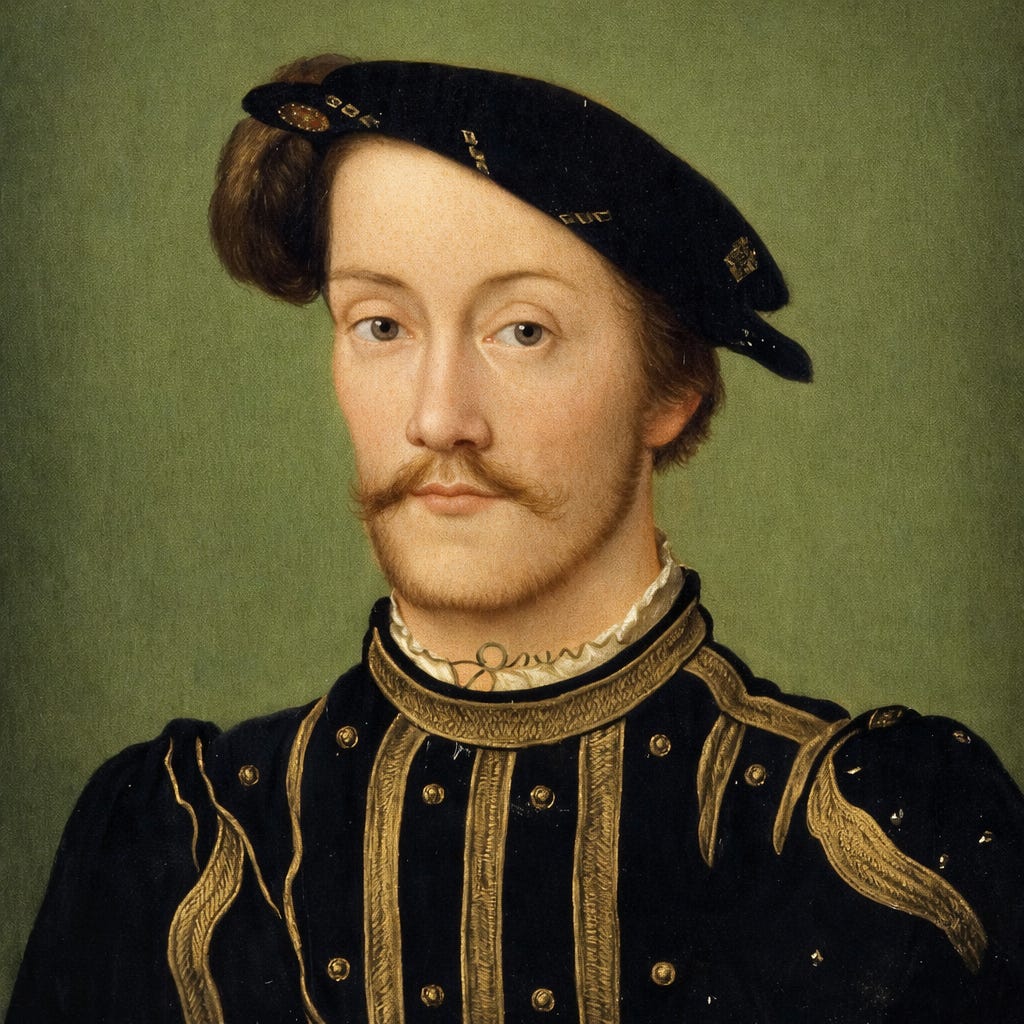
That’s Hamlet. De Vere lived a refined and elite, enlightened and retrograde, sometimes outlaw and brutal life among the nobility under Queen Elizabeth.
“Who Really Wrote Shakespeare? Shakespeare Authorship 101,” an entirely unassuming half hour talk by retired attorney Alex McNeil, sums the argument concisely. And any number of other dissident talks and interviews online, including many by the Shakespeare Oxford Fellowship, reveal the plain truth as well, as do countless books and articles by highly accomplished dissident or independent scholars. The identifying facts are widely known and available, just not accepted or allowed by the establishment — rejected, ignored, disparaged by “traditionalist” scholarship, by scholars and other officials who insist that the businessman from Stratford wrote the works. Apparently too many big careers and paydays, too much propagandistic ideology and big business is at stake to allow a plethora of evidence and truth to interrupt.
It’s long since time that the traditionalists of the establishment put on their big boy pants and acknowledged this dramatic wrinkle of history. The real story of authorship, the factual explanation, makes for a genuine literary thriller, while its obtuse treatment by the establishment makes it a galling sociological farce, a case of “Orwell’s Problem” gone wild — as preposterous institutional bullshit that only a really disgraceful and ingrained culture of pompous arrogance and slavish obeisance could sustain for this long — for centuries. That’s the empire for you in its institutional guise — stunningly pre-Enlightenment, a pre-Renaissance quasi-religious mentality of high priests who know it all on faith, without question.
Well, let’s question.
Let’s let the long overdue slam dunking begin, since the establishment has been so obnoxious and irresponsible in its baseless denials, to the point of fraud.
Were the intensely accomplished and much exalted literary works of “Shakes-peare” really so explosive politically in their time that the identity of the author needed to be covered up? Were there additional even more fundamental reasons for the misdirection? And if so, who could possibly have written the renowned works if not the traditionalists’ choice, the businessman from Stratford?
“Shake-speare,” the playwright’s most common pen name among many, was hyphenated on his published literary works about half the time, a name not hyphenated in society otherwise. Hyphenation was a common structure of the myriad pen names of the era, a telling literary flourish. And so “Shake-speare” even on its surface is indicative of identity or lack thereof. It’s a nom de plume, one that was eventually passed off as a borrowed-name pseudonym for the businessman from Stratford, providing an extra layer of plausible deniability.
As for who could have written the works, let’s start with the plainest thing: training and environment and autobiography. In 1562 at age forty-five, twelve year-old Edward de Vere’s wealthy nobleman father, John, dies of an unexplained sudden illness. Young de Vere’s mother quickly remarries a social inferior, to the youth’s great distress. These crucial details structure the great play Hamlet, where fast-acting poison is everywhere and the swift and troubling remarriage with endless complications is the emotional engine of the play, written as if wrenchingly autobiographical. As in Hamlet, after the sudden death, de Vere’s mother quickly got “married [to a man]… / no more like my father / Than I to Hercules: within a month.” (Edward de Vere’s mother, Margery Golding, remarried little more than a year, at most, after the death of her husband, John de Vere.)
De Vere is then raised not with his mother and stepfather but in the household of William Cecil, Lord Burghley, the Secretary of State and Lord High Treasurer of England, at the nerve center of Elizabethan power. He is later educated at Cambridge and trained at Gray’s Inn for law, which provides him knowledge and experience of the law from the inside out, as demonstrated in the works. He lives at court among diplomats, lawyers, scholars, grandees in the exact social machinery the plays handle as if by instinct. The Shakespeare canon isn’t just smart. It thinks like an insider and is written from the point of view of the nobility. It knows procedure, etiquette, patronage, dynastic dread, the moral language of governance — not as textbook knowledge, but as lived reality.
“Shakespeare” doesn’t write from nowhere. De Vere’s uncle is Arthur Golding — the ostensible translator of Ovid’s Metamorphoses, the 1567 English version that becomes the major Ovid form for the age. Shakespeare is Ovid-soaked, and Golding isn’t some distant influence floating in the ether — he’s family, and not only family but one of young de Vere’s guardians after his father’s death. De Vere lived with his uncle Arthur Golding at the time he was supposedly translating Ovid. Yes, the Ovid that feeds Shakespeare was produced inside the very household that produced de Vere, allowing for strong educational and cultural transmission, to say the least. In fact, young de Vere himself, given his training and abilities, interests and literary flair, fluent in multiple languages pre-teen, is likely to have written much or probably all of the renowned Metamorphoses translation rather than his uncle — so Shakespeare-like is the work. The Metamorphoses translation is far more literary and imaginative than Golding’s typical historical and religious translations. Robert Prechter in Oxford’s Voices examines the difference between de Vere’s writing under his uncle’s pseudonym and Golding’s actual writing under his own name.
From the same orbit comes John Lyly. Lyly dedicates the second Euphues book to de Vere, and Lyly serves as de Vere’s private secretary. Lyly’s writing is acknowledged to be closer to Shakespeare than most contemporary prose. But once you know what Elizabethan rank required — that a nobleman could not safely present himself as a commercial playwright — the Lyly connection becomes more than influence. It becomes a practical channel. A brilliant and contentious aristocrat has every reason to remain publicly uncredited (as forced by a kind of noble social code, and other politics), while a secretary has every reason to publish and make a name for himself. And unlike the speculation in the conventional authorship story, this mechanism is not airy — it’s grounded in the documented employment relationship.
Plenty of evidence points to not merely Lyly’s involvement but to the reality that Lyly was only one of numerous borrowed-name protective pseudonyms used by Edward de Vere. Other pseudonyms include Robert Greene and Thomas Nashe, supposed author of the prose satire Pierce Penniless [spear-shaker de Vere himself] his Supplication to the Divell and the novel The Unfortunate Traveller, among other works. De Vere had powerful enemies close at hand and much to be cautious about in regard to his name and reputation.
Robert Prechter argues persuasively and meticulously in his massive work Oxford’s Voices: What Shakespeare Wrote Before He Was Shakespeare that de Vere began publishing under pseudonyms at age ten and continued to do so for the rest of his life, while publishing occasionally under his own name for a time in his youth as well. Prechter shows that de Vere published “song poems” and a translated version of Ovid’s fable of Narcissus under various pseudonyms at age ten, while writing and publishing the Tragicall Historye of Romeus and Juliet under the pen name Arthur Brooke by age twelve.
Then there’s the evidence of an especially notable actual surviving book linking de Vere to the works of Shakespeare. A Geneva Bible owned by de Vere has extensive marginal markings, and those markings line up heavily with the kinds of biblical echoes and patterns that show up across the works. It’s well studied. The de Vere Bible is a physical artifact linking the works of Shakespeare to de Vere.
Take travel. De Vere’s continental tour is not legend — unlike the speculative myth that is the conventional tale of Shakespeare’s identity as Shakspere of Stratford — the tour is documented. De Vere travels through France and Germany and then spends roughly a year in Italy, including Venice, and he writes from Siena to Lord Burghley in January 1576. Shakespeare’s Italy isn’t just pretty names and vague atmosphere. It’s Italy as a working system — mercantile habits, law and finance, city-to-city social texture. That is exactly the kind of knowledge that comes naturally to a court traveler who watches these places operate, and then later turns experience into drama. De Vere gives you a direct take from lived Italy to written Italy. Observations of architecture, prisons, and private rooms in several cities in Italy are documented to correspond with descriptions in the plays in ways that go past casual travel reading to the experiential, requiring first-hand knowledge. Juliet’s room and surrounds are frequently cited in this regard.
The travel record gives many specific parallels that historians cannot or should not ignore. On de Vere’s return across the English Channel in April 1576, reports describe pirates seizing his ship, robbing him, and stripping him “to his shirt.” In Hamlet you find an odd episode — pirates intercept Hamlet at sea — and Hamlet reports, “I am set naked on your kingdom.” That’s a concrete life-event connection that fits in the same direction as everything else. There are many such autobiographical connections between de Vere and the works of Shakespeare, far beyond his continental travels, involving questions of the faithfulness of his wife, the uncontroversial depiction of Lord Burghley as Polonius, the motivational and situational autobiographical basis for Hamlet and myriad other details in Shakespeare that correlate intimately with the known details of de Vere’s private and public life.
Consider politics and patronage and de Vere stops looking like a mere well-educated and travelled man and starts looking like the kind of uniquely positioned person who could write these works at all. Shakespeare’s plays are politically saturated and politically careful with great detail. They show someone who understands power as it really works: faction, surveillance, legitimacy, succession panic, propaganda, the cost of saying the wrong thing within earshot of a throne. De Vere lived that. He also received an extraordinary Crown annuity — £1,000 per year beginning in 1586 — an enormous sum, continuing for years, described in the record as relief for financial distress. There is no receipt labeled “paid for Shakespeare,” but de Vere is the kind of person the state supports and manages, financially as well as politically. State-adjacent literary production, including the celebration and containment of national narratives, fits his world naturally. Immediately after gaining the annuity, Bob Meyers notes, Shakespeare began producing a lot of history plays supporting the Queen’s Tudor dynasty, propaganda plays. Meyers adds:
The De Vere line went back to William the Conqueror; it was England’s oldest royal family. In effect, he was writing his own history, aided by Holinshed’s Chronicles, just published in 1587. The British history plays are pro-monarch, anti-rebellion, pro-stability.
Then there’s reputation. Edward de Vere, Earl of Oxford, was no obscure person in any sense, let alone an obscure writer. Contemporary writers praised him as the leading court poet. In A Discourse of English Poetrie (1586)
William Webbe names him as “the most excellent” of Elizabeth’s courtier poets.[181] Puttenham’s The Arte of English Poesie (1589), places him first on a list of courtier poets…. Puttenham also says that “highest praise” should be given to Oxford and Richard Edwardes for “Comedy and Enterlude”.[181] Francis Meres‘ Palladis Tamia (1598) names Oxford first by social rank of 17 playwrights listed who are “the best for comedy amongst us”, and he also appears first on a list of seven Elizabethan courtly poets “who honoured Poesie with their pens and practice” in Henry Peacham‘s 1622 The Compleat Gentleman.[181] Steven W. May writes that the Earl of Oxford was Elizabeth’s “first truly prestigious courtier poet…”
Gabriel Harvey refers to de Vere as a central literary presence. And on and on.
The simple question is — which candidate is independently documented as a serious writer and dramatist in his own time? De Vere has that documentation, and then some. Shakspere of Stratford does not have anything comparable, nothing at all that shows him being treated, in life, as a figure of letters, in any sense. The pseudonym, Shakespeare, often written as “Shake-speare,” gets praised of course but not Shakspere as an individually recognizable person.
The pseudonym Shake-speare relates to de Vere in multiple ways — as part of his family crest, as link to his champion jousting and athletics, as the sword, the “Pierce,” of Pierce Penniless (written under the pseudonym Nashe) when he was struggling with funds and scheming publishers. De Vere was even referred to as “young Will” as a youth after his nemesis guardian William Cecil, Lord Burghley. And so in this way, among others, you get the borrowed-name protective pseudonym “William Shakespeare” for the politically fraught and scandal-plagued brilliant literary nobleman, Edward de Vere, Earl of Oxford.
Also of note, Edward de Vere
was sought after for his literary and theatrical patronage; between 1564 and 1599, twenty-eight works were dedicated to him by authors, including Arthur Golding, John Lyly, Robert Greene, and Anthony Munday.[5] Of his 33 dedications, 13 appeared in original or translated works of literature, a higher percentage of literary works than other patrons of similar means.
Looking at de Vere’s famous sonnets through logic rather than romance is revealing as well. The narrative poems dedicated to the also politically vulnerable Henry Wriothesley have an unusually intimate, high-stakes tone — less like a tradesman flattering a patron, as the conventional historical myth mistakes (or pretends), and more like a socially proximate elder addressing a younger noble whose marriage, lineage, and political alignment matter. Wriothesley fits de Vere’s world easily — aristocratic networks, marriage pressure, succession-adjacent anxieties. And the sonnets’ concerns — legacy, disgrace, favor, enforced silence, reputational survival — read like the concerns of a court noble who has lived through falls from favor and knows what speech can cost.
There is very little comparison or connection that can be made between Edward de Vere of Oxford and William Shakspere of Stratford, though they both had rogue aspects to their characters. They are linked mainly by the one being passed off, eventually, as the (modified) borrowed-name pseudonym of the other. What is missing in the life of the businessman from Stratford is precisely what matters if you’re talking about authorship — the documentary footprint of a literary mind. No letters that sound like the author. No notebooks. No drafts. No manuscripts. No personal library. No evidence of continental travel. No evidence of embedded court life. Even the will of Shakspere, one of the richest personal documents to be found, reads like the will of a property-minded businessman and family man not like the will of the most powerful literary mind in English leaving behind papers, books, and a lifetime of writing. Unfortunately, de Vere himself left no will.
There’s no evidence that the unprincipled Stratford businessman was even literate, nor that his family was literate either. In fact, the evidence that does exist, indicates that Shakspere led the life of both an unscrupulous and greedy businessman who could be bought, say, for the purpose of providing a borrowed-near-name protective pseudonym for de Vere. There are many indications that “Shake-speare” as pseudonym was an open secret at the time, necessitated, even demanded, by the power politics, aristocratic mores, and concerned officials with more power than de Vere, such as Lord Burghley and the Queen. De Vere’s first cousin-in-law, the unfortunately named John Stubbs, had his hand cut off for writing a pamphlet questioning a potential marriage of Queen Elizabeth:
Initially Queen Elizabeth had favoured the death penalty but was persuaded by adviser John Jovey to opt for the lesser sentence. …Stubbs’ right hand was cut off on 3 November 1579. At the time Stubbs protested his loyalty to the Crown and immediately before the public dismemberment delivered a shocking pun: “Pray for me now my calamity is at hand.” His right hand having been cut off, he removed his hat with his left hand and cried “God save the Queen!” before fainting. Stubbs was subsequently imprisoned for eighteen months.
While heavily propagandizing for the Queen in the most political plays, de Vere also criticized power and satirized top officials, and even doxxed them, notes Bonnie Miller Cutting, outing their their private writings in Hamlet, for example, in the case of the all but all-powerful Lord Burghley, satirized as Polonius. The use of even an open-secret pseudonym was more-or-less a requirement for nobility like de Vere, for multiple and sometimes conflicting reasons. Many writers at the time were tortured and imprisoned or killed for offending the monarchy. And nobility could be stripped of major and costly privileges, honors, titles, and offices for gaining money or recognition in commercial ventures not in service of the Crown — “the English version of the feudal law, dérogeance,” Tom Townsend notes, and the “stigma of print,” of being menial and not “serving the monarch.”
As for the entirely missing literary traces of Shakspere, the businessman from Stratford, you can always claim that any and all literary records and writings were lost. But that’s not evidence — it’s a tortured and fantastical escape hatch. And once you lean on it, you’re asking the reader to accept a very specific kind of miracle — that the greatest writer of the language lived a writing life that left essentially no writing-life trace, while producing works that read like the output of an elite court insider with the precise elements of education, travel, political proximity, and intimate autobiographical details unique to Edward de Vere.
You would need to be the biggest fool walking to believe the total horseshit of Shakspere as author once you begin to get a glimpse of the real scope and depth of the facts. You would need to insist on being a complete ignoramus of history and the facts. Or a liar.
Can you hear the dunkings slamming? Can anyone not see the degree of fraud involved? Can anyone not understand the culture of the establishment a little bit better now, how easily the-plain-as-day is denied when reputations and investments, literary or otherwise, are at stake? Can the establishment be embarrassed into the truth, or perhaps more likely in this case, sued into it?
In very recent years, a form of last-ditch desperate establishment ass-covering has begun to allow that multiple authors may have written the works of Shakespeare. Literary collaborations are commonplace, so, sure, why not? Meanwhile, any existing authorship controversy continues to be denied, let alone the overwhelmingly obvious, that de Vere wrote the works of Shakespeare, among other works under additional protective pseudonyms. The reality of de Vere’s multiple borrowed-name pen names — beginning at age 10 — can be abused to facilitate specious multi-author notions for “Shake-speare” — as long as you get the facts wrong.
There continue to be many new lines and details of research to pursue in regard to the authorship of de Vere, expanding the longstanding cottage industries of research and the revelations of dissident and independent scholarship, undertaken and achieved outside and against establishment ideology for many decades — forced outside.
The de Vere explanation for the authorship of the works of Shakespeare isn’t one clever coincidence. It’s a whole structural fit — contextual, evidentiary, autobiographical. De Vere’s education explains the learned range. His court life explains the political realism. His household ties to Golding explain the Ovid influence at the heart of Shakespeare’s imagination. His relationship to Lyly makes the masked-authorship mechanism socially workable. His Italy tour supplies a real-world basis for Shakespeare’s Italy. His pirate-stripping episode matches an odd detail in Hamlet that doesn’t need to be there unless it came from somewhere personal. Autobiographically, de Vere is Hamlet just as some of the play’s other main characters are based on the real-life figures in de Vere’s tight orbit. De Vere’s first-rate literary reputation shows he was already a highly regarded writer before the Shakespeare name becomes culturally dominant. His Crown annuity places him inside the realm of managed cultural production under political constraint.
And these are just the tips of the icebergs of the extensively documented details, arguments, and evidence for de Vere as author that are so hypocritically and irresponsibly and fraudulently rejected and ignored, denied by the establishment, in lieu of the sheer fantasy that the peripheral businessman Shakspere, who can’t even be proven to be literate, was the most renowned writer in the language. Shakespearean drama indeed. Shakespeare’s greatest joke, and continued political intrigue. Great works of literature cannot be political and cannot be propaganda, don’t you know? It’s the credo of much of the literary establishment, in open defiance of the facts about the writings of the acclaimed greatest literary figure in the language. That’s exactly what many of the greatest works of Shakespeare are — pointed political propaganda. The traditional identity falsehood conveniently blurs the matter badly, which then affects and infects establishment ideology and cultural and literary and creative understanding. Talk about poison and jokes.
Establishment intellectuals as professional liars pushing bankrupt and fraudulent ideologies is a lineage as old as time. One that provides endless fodder for research throughout history. There should be departments of intellectual fraud in every field of study. I suppose we’ll need to settle for the books, sometimes few, sometimes many, that trail in the wake of the duplicitous. We are centuries beyond mere mistakes of theory and assumptions regarding the multi-layered scandal of the falsified identity of the leading luminary of the language, “Shake-speare.” The identity question remains a four-century-old real-life Game of Thrones.
Michael Delahoyde notes that
The eminent and controversial Oxfordian Charles Beauclerk has asserted, “if you get [the identity of] Shakespeare wrong, you get his plays wrong…if you get [the identity of] Shakespeare wrong, you get the Elizabethan age wrong – its literature, its culture, its politics.”
Delahoyde adds, Beauclerk understands too that
…if you get [the identity of] Shakespeare wrong, you get literature wrong, and probably you get the very phenomenon of creativity wrong.
You get literature, biography, general history, literary history, culture, politics, creativity, and ideology wrong. You get writing wrong. You get the discipline and the field of study wrong.
Given the great mass of evidence and research produced since the groundbreaking book Shakespeare Identified (1920) by Shakespeare teacher-become-scholar J. Thomas Looney, if today as a scholar you claim to have seriously considered the identity of Shakespeare and still get it wrong, you are a clown or a fraud. If you are a general intellectual who has seriously considered Shakespeare’s identity and still get it wrong, then you are an absolute fool at best. The professional liars have been lying for so long that they don’t care to stop and seemingly cannot, and it badly confuses and clouds people’s judgment far and wide.
Considering the illiterate businessman Shakspere of Stratford to be the author of the works of Shakespeare is a perverse and stupid joke perpetuated by academic frauds and commercial charlatans — charlatans of all sorts — conning the credulous, the unwitting, and the gullible. It’s an anti-intellectual lie that distorts and destroys genuine knowledge of literature, writing, society, history, politics, culture, ideology, and much more. It’s a lie that distorts the works, disgraces culture, and deforms minds and mentalities. Common decency and intellectual honesty call for revolution in this sphere as in many others. It’s amazing they’ve been allowed to get away with it for this long. It says a lot about “polite society” and “respectable society.” Dismissive of reason and argument when not convenient to vested interests and personal stakes, material and reputational possessions and pretensions. Impervious to analysis, evidence, and facts. Ironically above reproach. It says a lot about society and politics in general.
In addition to the reality that any evidence for Shakspere of Stratford as author of “Shake-speare” — rather than protective pseudonym — is fundamentally non-existent, dissident scholars and other independent minds, via the Shakespeare Oxford Fellowship and elsewhere, explain in overwhelming detail how all the evidence shows de Vere to be the author. The more you examine de Vere’s life, the more you understand: How could he not be Shakespeare? In a revealing talk, Bob Meyer’s notes that from ages four to twelve (when his father died), de Vere lived with and was tutored by Sir Thomas Smith “one of the two greatest linguists in England,” who spoke many languages, owned hundreds of books in Greek and Latin, and was dean of Eton College. Thus the renowned wordsmith as a young boy received the pre-eminent early start of early starts.
More specifically:
Like many children of the nobility, [Edward de Vere] was raised by surrogate parents, in his case in the household of Sir Thomas Smith.[13] At eight he entered Queens’ College, Cambridge, as an impubes, or immature fellow-commoner, later transferring to St John’s. Thomas Fowle, a former fellow of St John’s College, Cambridge, was paid £10 annually as de Vere’s tutor.[14]
The apple did not fall far from the tree — among other mighty and looming trees, in a veritable food forest of art and intellect. Edward de Vere’s father, John de Vere
…was known as a sportsman, and like several noblemen of his day, he retained a company of actors. The troupe, known as Oxford’s Men, was retained by the Earl from 1547 until his death in 1562.[17][18] His circle included the scholar and diplomat Sir Thomas Smith and his brothers-in-law, the poets Henry Howard, Earl of Surrey and Edmund Sheffield, 1st Baron Sheffield, and the translator Arthur Golding.[19]
Another tutor of de Vere’s was Laurence Nowell, the founder of Anglo-Saxon studies. After his father’s death, de Vere was tutored at Cecil House, “a gathering place for scholars” — the home of de Vere’s guardian William Cecil, aka, Lord Burghley, Secretary of State and High Treasurer of England. The early life and education of Edward de Vere gives no little understanding of the total situation that produced the great bard. Next up would be Cambridge College and Gray’s Inn for law. Then an extended tour of continental Europe — Italy especially.
While tutoring de Vere, Nowell received the “world’s only copy” of Beowulf that wouldn’t be reprinted for “another one hundred years,” a tale which even traditional Stratfordian scholars explain is echoed in Hamlet. How could this be? if not written by de Vere. The self-evident explanation makes sense. Interminable speculation and fantastical reaching do not. Countless and particular pertinent details that explain authorship continuously point to de Vere and away from everyone else, especially away from Shakspere, the illiterate Stratford businessman. The works are pervasively autobiographical, correlative, and connected to de Vere’s life in every aspect and time.
Could William Shakspere of Stratford have even been literate? Possibly, but there’s no evidence. Could Shakspere have attended grammar school, or any school? He could have, but there’s no evidence. Does grammar school explain the vast learning in the works of Shakspere? Not even close. Could Shakspere have been an autodidact and made himself literate? Possibly, but there’s no evidence. Could Shakspere have situated himself in high society and gathered all the private and public details of Edward de Vere’s life as Earl of Oxford that flood and illuminate the works of “Shake-speare” and thereby written the works as bizarre symbiotic homage to de Vere? Of course no one has proposed such a preposterous theory of symbiosis because at this point one might as well suggest that little green men live as puppet masters on the moon and manipulate the lives of humans through space.
Not only is there no evidence for Shakspere of Stratford as author, rather than borrowed pseudonym, copious amounts of evidence exist that strictly rule him out as author, while accounting for the function of the variation of his name as protective pseudonym.
When one candidate for authorship explains the works at every major junction — education, sources, travel, politics, patronage, reputation, literary focus and style, wholesale autobiography, and more — and the other candidate can be made to work only by repeatedly appealing to missing evidence, unknowable learning, undocumented access, and endless ethereal speculation, the logic isn’t subtle. To say the least, the most economical and evidence-based account (one can also fairly say the obvious account) is that “Shakespeare” was an elite court insider with well-documented literary stature and the lived experiences the plays repeatedly transform into drama — and Edward de Vere is that person.
There’s also a lot of sometimes complicated and coded hints and semi-obvious jokes that the involved figures of the time created in portraits, statues, and writings that the dissident scholars have painstakingly uncovered and explained exactingly as revealing both the actual author, de Vere, and the phony attribution of authorship to Shakspere. These deliberate clues to the necessary charade are very clever and very revealing. But the mere plain facts of autobiography and social environment, literary and historical analysis should be convincing enough by far. Should be — if one is able to summon a bit of honesty and a minimal amount of integrity — always an iffy question in certain establishment circles of ideology.
Occam’s razor cuts hard again and again and points directly at de Vere every time. Just as it points very far away from everyone else, especially an illiterate pay-for-play businessman from Stratford. This has been clear, or should have been clear to any and all concerned, throughout the past century, at the least, ever since the 1920 publication and broad dissemination and discussion of Shakespeare Identified, and the supporting continuously widening river and torrent of works and discoveries which have been met with more than a century of vitriol and denial, career-destruction and academic fraud, anti-intellectualism and presumption by an ongoing tragicomedy of true believers and frauds. These are the benighted authorities of deep or phony faith in the whopping tale of the tax-evading, grain-hoarding, illiterate businessman from Stratford as the author of the works of Shakespeare, precisely the sort of figure who would be willing to lie on behalf, on command, of Edward de Vere and the realm, if necessary.
The documented life of William Shakspere of Stratford does not remotely look like the life of a great writer, and it does not explain the works without a long and fantastical chain of special pleading, that is wholly hallucinatory. Given a bit of context, including for the needed use of a pseudonym, there exists nothing but baseless establishment conjuring on behalf of the Stratford man as author. How many times need it be exposed? Another ten thousand? It’s not that a man of humble origins couldn’t write great literature. It’s about something much plainer — all the available evidence — something wholly inconvenient to the conventional establishment views — the fatuous views of the vested, conformist bitter clingers who dupe the unwitting. Oh, dang! There goes their prestige, their power, their authority, their profiteering, maybe even their careers. Why do I think they’ll be fine?
So now we’ve seen some of the main elements of the panoramic evidence-based case for Edward de Vere, Earl of Oxford, as Shakespeare and more. It’s amusing and instructive to consider the evidence-based case against William Shakspere, businessman from Stratford. Start again with the basic record. What is known about Shakspere comes almost entirely from legal and business documents — property purchases, tax disputes, lawsuits, grain hoarding (in time of famine), mortgages, theater shareholding. These records show a practical, ruthless, unscrupulous businessman. They show no trace of a literary life. No letters. No notebooks. No drafts. No marginalia. No correspondence with writers. No evidence of a personal library. No books mentioned in his will. No manuscripts left behind. This is not what the documentary footprint of a major writer normally looks like — in any period — and especially not in a period when writers routinely left letters, dedications, notebooks, and paper trails. The will is concerned with money, property, furniture, and family arrangements. It does not mention books, papers, plays, poems, or intellectual property of any kind. For the man who supposedly wrote the most important body of literature in English, these lifelong silences are not small gaps — they are canyons. You can always say records and things were lost, but once you say that, you are no longer pointing to evidence.
Then look at education. “Stratfordian” scholars often say Shakspere must have attended the local grammar school. There’s no evidence for that, but so what if he did? Grammar school education does not explain the range, depth, and texture of knowledge in the plays. Shakespeare does not just quote Latin tags. He thinks like someone trained in law. He writes with intimate understanding of court protocol. He handles statecraft, diplomacy, succession crises, and aristocratic psychology as if they are familiar terrain. He uses classical sources not as school exercises but as flexible imaginative tools. Nothing in Shakspere’s documented life shows where or how this level of training was acquired, or why it left no trace elsewhere.
Travel is another problem. The plays’ Italy is unusually specific, not just scenic, but procedural. Venice is a place of contracts, credit, and law. Padua is a place of learning. Verona has social rhythms. This is not the Italy of hearsay. The plays include actual neighborhood churches, houses, and other landmarks, Tom Townsend notes. Yet Shakspere is never documented leaving England. The usual answer — “he used books” — is wholly inadequate, because the plays repeatedly show the kind of knowledge that comes from moving through specific major and minor locales, not just reading about them. Again, you can imagine how he might have learned this, you can fantasize forever, but imagination is doing the work evidence does not.
Then there is court life. Shakespeare’s plays are saturated with an insider’s understanding of hierarchy: who may speak, who must remain silent, how favor works, how quickly it disappears, how dangerous the wrong word can be. These are not themes you stumble into by accident. They are habits of mind formed by proximity to power. Shakspere’s documented life places him outside that world. He does not appear at high court. He does not circulate among grandees. He is not embedded in aristocratic networks. To make him the author, you must believe he somehow absorbed such court consciousness secondhand, perfectly, without ever living it.
Reputation deepens the problem. During Shakspere’s lifetime, there is no record of anyone describing him as England’s great writer. No letters mourning his death as a literary loss. No contemporary comments on his genius as a mind. His death in 1616 passes quietly. The first sustained effort to elevate “Shakespeare” as a towering literary figure comes later, with the First Folio, assembled by others, years after his death. Contrast this with how poets and writers were usually recognized in their own time: through correspondence, praise, rivalry, complaint. The silence is nonsensical.
Supporters often point to the First Folio itself, but the Folio raises as many questions as it answers. It appears after Shakspere’s death with prefatory material that praises “Shakespeare” in oddly abstract ways — as a name, a monument, a phenomenon — without grounding him in a lived literary biography. And the ludicrous extremely manipulated and nonsensical portrait of Shakspere in the folio is a blatant wink-and-nod at the fake identity. Research has shown that it’s actually a modified mask — thus the grotesque unshapely appearance — fit over a portrait of Edward de Vere’s face. The joke was on, and it remained on, given the plays’ still explosive politics of succession and aristocratic propriety, and given the contentious ideological conditions and tyrannical politics of the day.
Even the signatures of William Shakspere undermine the argument for his supposed authorship. The surviving signatures are inconsistent in spelling and appear labored. That does not prove illiteracy but sits close to it, especially given the lack of any other writing, very far from the idea of a man who lived daily in writing, revision, and verbal precision. Once again, you can make-up explanations — injury, haste, clerks — but this is wild invention, continuous special pleading.
And then there is motive. Conventional wisdom on the identity question rarely asks why Shakspere would need to hide his authorship, because it assumes he did not. But given the dearth of evidence showing that the Stratford businessman could or did author the works, the question needs to be asked: why would an aristocrat need to hide authorship? And the answer fits the culture and the situation perfectly — aristocratic requirements, power politics, and the frequent imprisonment and extreme violence against the political truthtellers of the age, plus a potential profit motive. No one in power actually believed the businessman from Stratford was the author, so he was safe from punishment for the risky parts of the works, while de Vere benefitted from the token gesture of concealment that both protected his noble name and standing and may have allowed him to commercially profit from the plays.
Put all this together and a pattern emerges. To keep Shakspere as the author, you must repeatedly rely on what cannot be shown: lost papers, undocumented learning, imagined travel, invisible court access, silent genius, missing recognition. Each gap can be rationalized but not evidenced, nor explained without fantasy.
The problem is that Shakspere’s life does not behave like the life of the person who wrote these works, and the facts are that there is no evidence that withstands scrutiny that suggests it does. The works reflect elite education, court intimacy, continental experience, political involvement, and literary self-consciousness at the highest level. Oh, and the autobiographical details, intimate relations, and first-hand knowledge and experiences of Edward de Vere himself.
The businessman Shakspere’s documented life reflects commerce, property, litigation, and theater business — a life remote from the substance of the writings, relevant only for the convenient use of a slight variation of the name as fig-leaf pseudonym. All the evidence of Shakspere’s life is in no way remotely explanatory for authorship, but the alteration of his name is functional in multiple ways as both an imperative and telling pseudonym, a sleight-of-hand open secret among the establishment at the time. The name was phony. The royal and noble establishments breathed and bred and used falsehood like air. No coincidence that this lie is also today similarly perpetuated, now ludicrously and cravenly, by the pompous and pious authority-worshiping establishment, duplicitous and duping as it goes, conforming to modern powers and ideologies.
In Britain, likely the threat of the realm’s odious anti-free speech libel and slander laws has served to protect the liars, to the present day. And so the establishment position regarding Shakspere of Stratford as the great author remains, and remains garbage. The biographies posing Shakspere as the great author are long, speculative works of fantasy. Did you buy one of these many corporate money-makers? Should you not get your money back? Today the Shakespeare industry in Britain is worth hundreds of millions of dollars and employs more than ten thousand people in the Stratford area. The falsehood is enormously profitable. Countless dollars are at stake and many careers. Based on one of the many lucrative lies of empire.
The Shakespearean scoundrels really need to stop, the tragicomedy is so bad, as they continue to hold high court with academic fraud. The phony story and its establishment should be overthrown wholesale. Their lies don’t come close to withstanding scrutiny at any level. History does not work by asking what is barely possible. It works by asking what best fits the evidence that actually exists. And when you place Shakspere’s known and unknown footprints beside de Vere’s, the mismatch is not subtle and a question of a few missing details. It’s fundamentally structural, and a wholesale mismatch — an impossibility set beside the obvious, long since.
The history of the authorship is a readily understandable misdirection by pseudonym meant to protect the great political and literary power Edward de Vere — a complex schemer himself — in highly charged political milieus, while he lived. The continued fakery also protected the political scheming and power of the court from the pointed and politically explosive plays when they were collected and published after his death.
The continued phony ignorance and wholesale distortion of the evidence and best available knowledge showing Edward de Vere to be the obvious author of the works of Shakespeare, among other pseudonymous works, amounts by now to what may be an unprecedented degree of academic fraud, also commercial fraud, with potentially criminal implications.
It’s political garbage and a disgrace. It discredits the broad literary establishment and anyone connected with it, though, it must be said, as do many other things.
Much more could be said. And has been. And will be.
Go to the Shakespeare Authorship Coalition site if you want to learn more, get involved, or take action by signing their increasingly popular, modest, and understated declaration.
In 2013 the Shakespeare Authorship Coalition challenged the Birthplace Trust to participate in a mock trial of the Shakespeare identity issue and offered to donate 40K pounds to them if they succeeded in proving the case for Shakspere beyond reasonable doubt. They refused, even after the SAC published the challenge in a full-page ad in the Times of London Literary Supplement. It embarrassed them enormously to have to decline, thereby showing that they didn’t have the courage of their convictions, but better than participating and losing. See the challenge letter and donor list.
POST VIA LIBERATION LIT
 A Practical Policy