Eddington Versus One Battle After Another
POST VIA LIBERATION LIT
There’s a major difference between the two recent political and culturally critical movies One Battle After Another and Eddington that is telling and that may account for One Battle being more enthusiastically received than Eddington.
For all its flaws, One Battle takes a clear and strong partisan liberatory stand with the oppressed and would-be revolutionaries against the oppressors. One Battle is clearly “An Antifascist Movie at a Fascist Moment” in the words of Michelle Goldberg even though it massively kneecaps its own potential and achievements.
One Battle glamorizes and validates action for social change while empathizing with and somewhat humanizing the plight of the oppressed. The movie also excoriates the derangement of the vicious sick white male plutocracy and their hired guns who uphold and benefit from the destructive and unjust status quo.
Eddington on the other hand minimally nods to bits of unjust reality and some delineation of good and bad while engaging it much more marginally than One Battle. For all of Eddington’s mimetic accomplishment, the movie undercuts intelligence, especially liberatory and protective partisan intelligence. Eddington discredits or contradicts nearly everything and everyone’s professed positions and actions and thereby guts life of a lot of the clarity and power of principle, knowledge, healthy emotion, and protective partisanship, the liberatory. The movie guts much sense and stability and meaningful ways of being by presenting the half-blind and the irate and the uncertain and the confused as full reality. This is not exactly what anyone needs more of in these purposefully deluded and inflamed times.
Eddington‘s cross-spectrum negativity and discrediting effectively hides much good reality and healthy possibilities, giving a false and unhealthy impression of life; whereas, One Battle After Another revels in vital liberatory moments, including some very badly needed expressions of healthy emotion and insight for use in this turbulent and desperate day and age. One Battle does all this despite being the unfortunate structural and representational trainwreck of a movie that it also pervasively is.
Journalist and literary critic Rebecca West once noted that “A copy of the universe is not what is required of art; one of the damned thing is ample.” Eddington appears to copy the universe in presenting the depressing oppressive and confusing elements of reality, while botching and gutting the liberatory elements, and so does not present a full sense of reality. Illumination, inspiration, healthy emotions, and effective actions — these too are features commonly found in reality or readily imagined but are scarcely found in Eddington — let alone much greater possibilities and transcendent or impactful ways of being, artistically presented and created as story.
Eddington the movie is fixated by what becomes its own murderous mess of Eddington the town. In the movie — “spoilers” here — the conservative sheriff murders a mentally ill homeless man and then murders his political opponent, the liberal mayor, and his son. The sheriff’s right-wing pro-gun public bellicosity leads to voiceless antifa figures flying into town on a private jet — or fake antifa figures being flown in by the wealthy as a false flag operation — it’s indeterminate — to confront the sheriff, leading to a spiral of ever greater violence.
The end result is that the big data plutocrats wind up in exploitative material and political control of the town, which the murderous sheriff never actually cared or knew all that much about — the data plutocrats, not the town. The conservative sheriff was just sick of being contradicted and humiliated by the liberal mayor — and his private family life was going badly, also connected to the mayor. Self-contradictory and ultimately homicidal grievance politics in America — Eddington as Little America, or Little White Empire. And that’s it — the movie Eddington, the town Eddington. It represents the negative elements of society that everyone already knows all about — what is discussed and demonstrated over and over and over again online, on phone, in real life, on endless repeat. But that’s not all of reality and life — let alone the possible and the imaginable.
Rebecca West where are you now? “A copy of the universe is not what is required of art” — especially not the merely most confusing, violent and contradictory elements of the universe — “one of the damned thing is ample.” Thank you very much. I’ll pass. It’s possible to admire a work of art, the fastidious intimacies of its construction and action, while despising what it is. Give us an other to know and to experience so that we and our world may become greater others ourselves. Of course, on the flip side, be wary of giving us an equally fake alternate version of reality that may be all sunshine and light. These fractionally realistic types of art are not the worst things in the world, by far, but they can have their trying and troubling limits.
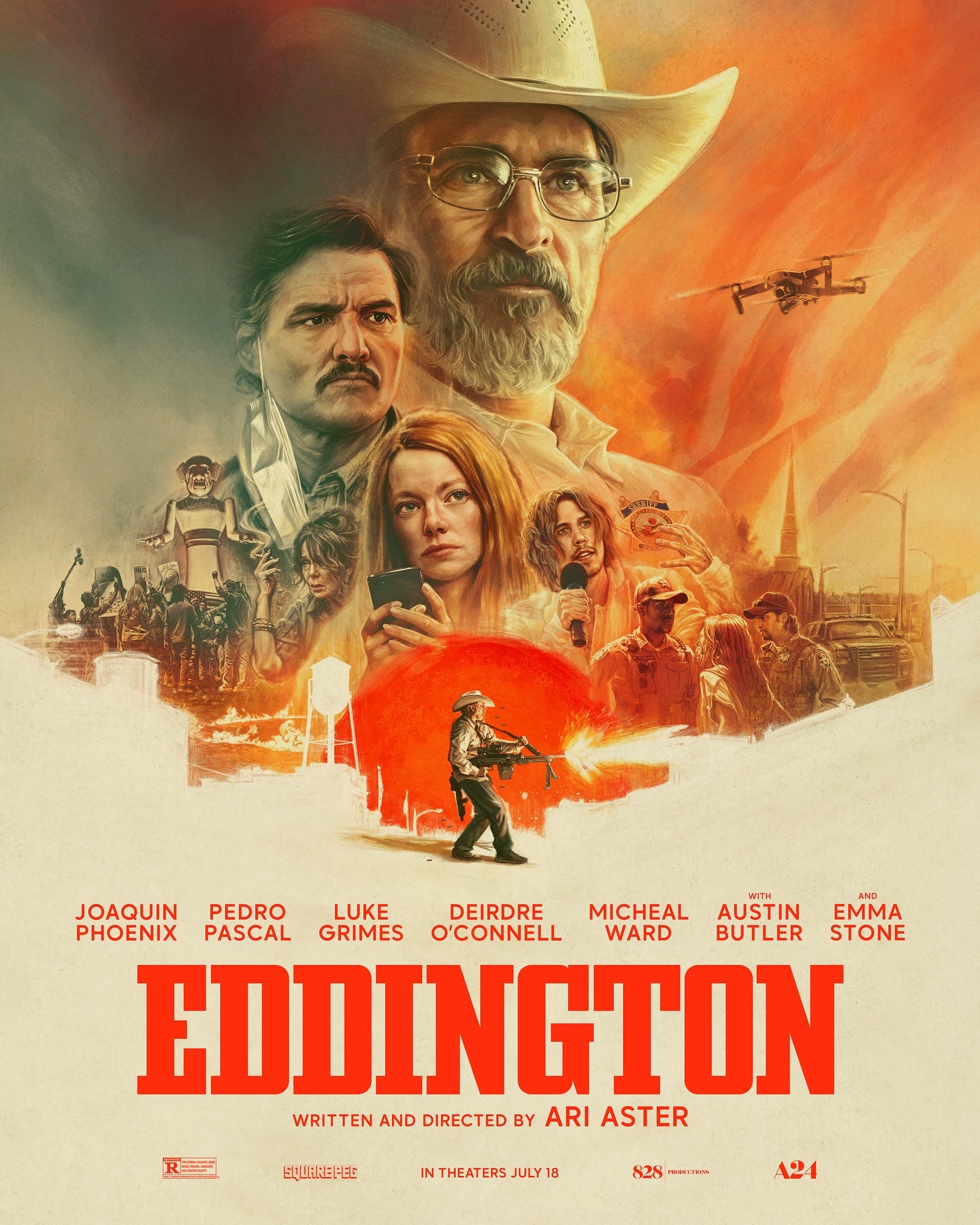
If only in place of the humbly-bumbly Joaquin Phoenix Sheriff in Eddington a bright orange Trump caricature had been cast instead — call it, Empireton! Now that would have been a sight to behold! — and possibly an epic story — especially if a true inspired and inspiring hero, however genuinely humble, were also cast alongside the fluorescent murderous incarnation of Evil in Little Fascist Eddington, America. Bye-bye miasmic and torturous realism, hello heightened reality!—
CriticismTrump Attacks America
·
September 30, 2025

Lecturing a gathering of the top American military officials yesterday in Quantico, Virginia, American President Donald Trump declared war against his own country — supremacist military war against t…
Instead we get a kind of suffocating, fractured, noxious realism that we already know and experience all too much — and in much deeper texture and broader scope than can be experienced in Eddington. Not only are there other options for art that surpass Eddington both aesthetically and normatively, Eddington, while posing as realism, falsifies reality in debilitating ways: truncating, distorting, and further confusing reality. One Battle After Another perverts and insults reality, too, on the one hand but on the other hand it upholds a clear and strong and often liberatory sense of life. One Battle also at least partly transcends reality to indicate greater possibilities and impulses for vital consciousness, action, and being.
While One Battle After Another gets a lot wrong, including much that undermines most anything and everything it might otherwise achieve as an aesthetic work of art and accomplish as a social and political artefact, Michelle Goldberg’s “An Antifascist Movie at a Fascist Moment” touches on a few important strengths of the story:
The film’s artistic success shouldn’t be reduced to its politics. But at a moment when an autocratic administration is trying to force cultural institutions into submission, it’s invigorating to see a Hollywood movie so fearless in its progressive convictions. “One Battle After Another” has complicated things to say about left-wing political violence and self-serving radicalism, but it takes a clear side in the broader fight between authoritarianism and resistance. …
…if “One Battle After Another” doesn’t celebrate revolutionary violence, it also doesn’t condemn the broad goals the French 75 fought for. Indeed, it celebrates those who quietly keep radical hopes alive. Its most winning character is Benicio Del Toro’s Sergio St. Carlos, a karate sensei who runs an underground railroad for undocumented immigrants, and who moves through the film’s chaos with Buddha-like serenity.
There is something subversive, in the best possible way, in the film’s vision of good and evil. The same week it came out, the [Trump] administration released a national security memorandum denouncing movements that “portray foundational American principles (e.g., support for law enforcement and border control) as ‘fascist’ to justify and encourage acts of violent revolution.” Watching “One Battle After Another” feels liberating in part because it’s heedless of all the new taboos Trump and his henchman are trying to force on us. The movie could scarcely be more relevant in Trump’s America.
Just as a “film’s artistic success shouldn’t be reduced to its politics” neither should a film’s artistic failures “be reduced to its politics.” But the film’s political failures are real and loom large and otherwise undercut its political, cultural, and social achievements and potential — as well as its own art.
People want to like One Battle After Another for a wide variety of compelling reasons, including its liberatory and antifascist qualities, and it has a lot of other positive qualities too, despite being otherwise so terminally vacuous. The film is obviously and fundamentally vulnerable to accurate critiques of blatant racism and sexism, not only in prominent scenes but structurally also — in particular, the upfront “blaxploitation” not least with its hyper-sexualization, plus the relative marginalization of all the minority characters who seem to be largely placed in a string to propel the plot for the near continuous presence and benefit of the white male main character and his one-note story. Deeply biased, at best, this tale, seemingly as old as time.
Such a critique barely scratches the surface of the problematic issues in One Battle After Another. There’s a lot of truth to Colleen Claes’ view that the movie is
pretty hollow: full of hacky Gen X humor and faux progressivism, with little point and even less character development (especially for the female characters, who are still somehow the driving force behind the story?) I cannot for the life of me understand how the “what time is it?” joke lasted for what felt like thirty minutes – precisely twenty-eight minutes longer than it needed to.
Going into much more detail on the cultural, political, and artistic problems of this Paul Thomas Anderson movie is Brooke Obie in “One Fetish After Another: PTA Exploits Black Women and Averts Revolution.” Lots of evident and de facto truth in her observations and conclusions:
Because the plot is a showdown between two white men fighting to hold onto Black and biracial women for reasons that keep them in constant conflict with each other. There’s no choice then but for the film to feel incongruent and exploitative of those thinly written Black women characters. …
Because Anderson is not interested in revolution. He’s not interested in vulnerable immigrants. Despite the many jokes about lusting for them, he’s not interested in Black women. He’s only interested in the interiority of white men.
That most reviewers of One Battle After Another seemingly do not or cannot readily see the severe and debilitating flaws of the movie is not much credible at this late stage of cultural history. Vacuous garbage and cesspool liberalism — these are significant elements of this film, woefully misjudged by writer/director Paul Thomas Anderson and producers. The movie’s skewering of hideous reactionaries, and the condemnation of fascist oppression, and the valorization of social justice workers and so on helps offset these flaws but does not eliminate them.
That most reviewers overlook these problems or ignore them and then hype what often amounts to a lot of tedious or warped Hollywood clichés as wonderful features of art or society is symptomatic of many other cultural problems besides. Look at him run, look at him drive, look at him shoot, look at him pose — what does he say? not much — what does he do? not much — what does it all mean? not much! Alas. Not in the time given. Not in the context of the story nor in the society outside the story, life. It could have been, should have been so much more. The most vital and crucial characters, politics, and elements of culture are frequently exploited, distorted, and marginalized throughout the film, badly undercutting the film’s genuine qualities and strengths.
The empty or loaded, offensive and otherwise demeaning elements of One Battle After Another are all too vivid and predominant in a story that in other ways has a generous, liberatory, and sizable heart. There appears to be a lot of critical overcompensating going on in both lauding it and remaining largely silent about the (white) elephants in the movie that essentially suffocate and lobotomize it. The movie gives itself its own poison pills, however unwittingly — to negative artistic, political, and cultural effect.
Eddington, written and directed by Ari Aster, similarly commits intellectual and experiential, ideological and emotional butchery on itself by falsifying reality in one gutted distortion after another. Sure, pockets and swaths of reality can be perceived through a fundamentally claustrophobic, chaotic, and violent lens, which the film constantly pushes by discrediting virtually everything it fronts. The internet bombards people with these sorts of self-discrediting, bewildering, and poisoned pockets and panoramas 24/7 — even and especially as huge areas of the internet and larger world are liberatory too. Anyone in their five senses avoids online carnage or explains and counters it and does not recreate it, even as many fall or dive often unwittingly into the madhouse and risk breaking their own neck and that of others.
It’s not that nothing can be learned or gained from movies like Eddington. It’s not that these shrunken-partial, gritty-chaos, or horror-view works of art are necessarily wholly unengaging. But it can quickly be suffocating to mind and imagination, redundant to the worst of life, and off-putting to both consciousness and intelligence. “One of the damn thing is ample.” Or, if you especially like this kind of crazed-gutter aesthetic and content, you might find a way to make it more revelatory, moving, impactful. Give us something more, something other, something moving up and out from the utter “damnation” so that we and our world may be and become something more alive and whole too. It’s badly needed.
If the self- and socially-eviscerating characters of Eddington, that is, Eddington, don’t know any better about themselves and the world, surely the director writer/director does. Find a way to express it. Show it! Tell it! Instead, in Eddington viewers are left to choke on the incoherent violent spectacle of forced chaos as all reality. If anyone wants to experience aggravation, chaos, and horror, they can quickly browse the internet, or even sometimes simply look across the office or worksite, or glance at the street outside. A one-to-one recreation of disaster does not rise to the level of a cautionary tale when it merely keeps viewers sunk in the bowels of the daily disaster of an omnipresent kind of life.
Oh, Ed! In the movie, we see that the Big Data ruled town of Eddington is fundamentally awful, violent, confused, confusing, all of that. No shit, Sherlock. What else ya got? Pity the people trapped in this universe and torn apart by its limited notions and crimped expressions of reality. This is the tragedy of a very limited and warped vision of life, in some ways reality, far from all ways — which is news to whom exactly? Liberatory epics far more than tragedies are needed today, including liberatory epics far better than One Battle After Another. Transcendent impactful epics that provide as much progressive or revolutionary possibility and inspiring reality and imagination as can be conceived and created are needed far more than stultified and claustrophobic tragedies of chaotic and violent life like Eddington.
If it’s tragedy you find compelling and insightful, any sweeping epic can easily contain the tragic, and much more besides — the comedic, satiric, the dramatic, the essayistic, the poetic, and so on. Liberatory epics can encompass and inspire all. You can find a few of these revolutionary epics at Liberation Lit, along with critiques and referrals for more beyond.
A Stoner Dad and a Murderous Sheriff Go To War. Against each other. Against the universe. It could be epic! And truly revolutionary, illuminating, and moving — such a movie or other long story. Who would win? Hopefully someone unexpected, for the sake of us all and everything, not the stars of these two shows — warped and dull, broken, and gutted of the liberatory, as they too much are. My vote is for Sabia and Leif and Dhyna but that’s just me.
POST VIA LIBERATION LIT
 A Practical Policy